Home›
Bolts
Bolts
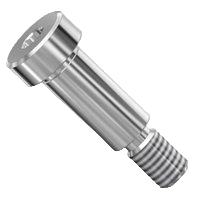
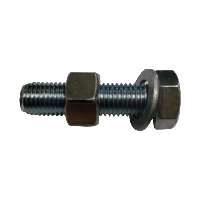
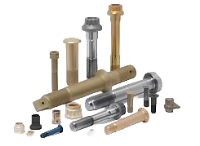
A bolt is a mechanical fastener with an externally threaded shaft designed to be tightened or released by torque with a matching nut. Bolts are used to fasten components together by passing through aligned holes, providing axial clamping force and resistance against shear forces.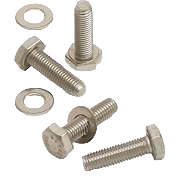
Frequently Asked Questions
- Grade 8.8 vs 10.9 vs 12.9 — which do I need?
- Grade 8.8: general engineering, medium-duty structural, construction — equivalent to approximately 800 MPa tensile strength. Grade 10.9: high-strength structural, automotive chassis, heavy machinery, some flange applications — 1040 MPa. Grade 12.9: high-performance, critical joint, automotive powertrain, mining equipment — 1220 MPa. Note: Grade 12.9 is susceptible to hydrogen embrittlement and stress-corrosion cracking; do not zinc-plate 12.9 bolts without specialty post-plating baking, and do not use in atmospheric corrosive exposure without additional coating. For outdoor structural, 8.8 HDG is the standard compromise.
- What's the difference between ASTM A193 B7 and B16?
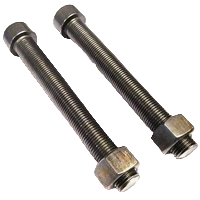
- Both are chrome-moly quenched-and-tempered stud-bolt grades. B7 is AISI 4140-equivalent, with maximum service temperature around 400°C. B16 is AISI 1Cr-½Mo-V steel, designed for high-temperature service up to about 550°C continuous — specified for steam-service flanges and high-temperature piping. B16 costs approximately 50–80% more than B7. For service below 400°C, B7 is almost always adequate and the cost-effective choice. Above 400°C (main steam, hot hydrocarbon processing), B16 is required.
- Can you supply bolts certified to NACE MR0175 for sour service?
- Yes. For H₂S service, ASTM A193 B7M is the standard — chemically identical to B7 but with hardness controlled to 22 HRC max per NACE MR0175/ISO 15156. Himalay's partner manufacturers supply B7M studs with hardness test reports and NACE-compliance certificate on every batch. For extreme-service sour applications (high H₂S partial pressure, chloride-containing), inconel 718 or Monel K500 studs are sourced on project basis.
- What's the MOQ for bolts?
- Commercial-grade structural bolts (8.8 grade, standard sizes, zinc-plated): typical MOQ 1,000 pieces per size and grade. Stud bolts in B7 or B7M (typical flange sizes ½"–1½"): MOQ around 500–1,000 pieces. Stainless (A2, A4, B8, B8M): MOQ 500–2,000 pieces depending on size. Specialty bolts (large-diameter, custom length, uncommon grades): MOQ 100–500 pieces. Mixed BOM orders consolidated across a project spec can reduce per-line MOQs considerably.
- Typical lead time for bolt orders?
- Commercial structural bolts (8.8, 10.9, standard sizes, zinc or HDG): 3–4 weeks from order to FOB Mumbai. Stud bolts and flange bolting in B7/B7M/B16: 4–6 weeks (hardness testing and MTC preparation add time). Stainless: 5–7 weeks (lower production volumes in Indian stainless bolt capacity). Specialty (custom length, specialty grades): 6–10 weeks. Consolidated flange-bolting project BOMs (studs + nuts + washers for multiple flanges) typically ship in 5–7 weeks.
- CE marking for structural bolts going to the EU — how is that handled?
- Structural bolting used in steel structures under the Construction Products Regulation (EU 305/2011) requires CE marking per EN 15048-1 (non-pre-loaded) or EN 14399-1 (pre-loaded). Himalay's bolt-making partners holding CE include initial type testing by a notified body, factory production control (FPC) audited and certified, and CE marking on packaging with a Declaration of Performance. For non-construction industrial bolting (e.g., flange bolting inside a pressure system), CE marking typically falls under PED-CE as part of the pressure-equipment conformity rather than the bolt itself.