• Homeβ€Ί
  • Disc Springs
  • Homeβ€Ί
  • Springsβ€Ί
  • Disc Springs
  • Disc Springs

    Source disc springs from India's verified manufacturers and exporters on Himalay. Browse the full range for industrial and export applications.

    Showing 3 items3 items
    Disc Springs sourcing

    About Disc Springs

    Disc (Belleville) springs across 960 listed configurations β€” 5 material grades from spring steel to Inconel 718, 16mm to 400mm outer diameter, 3 tolerance classes, edge-ground finish, built for series or parallel stacking.

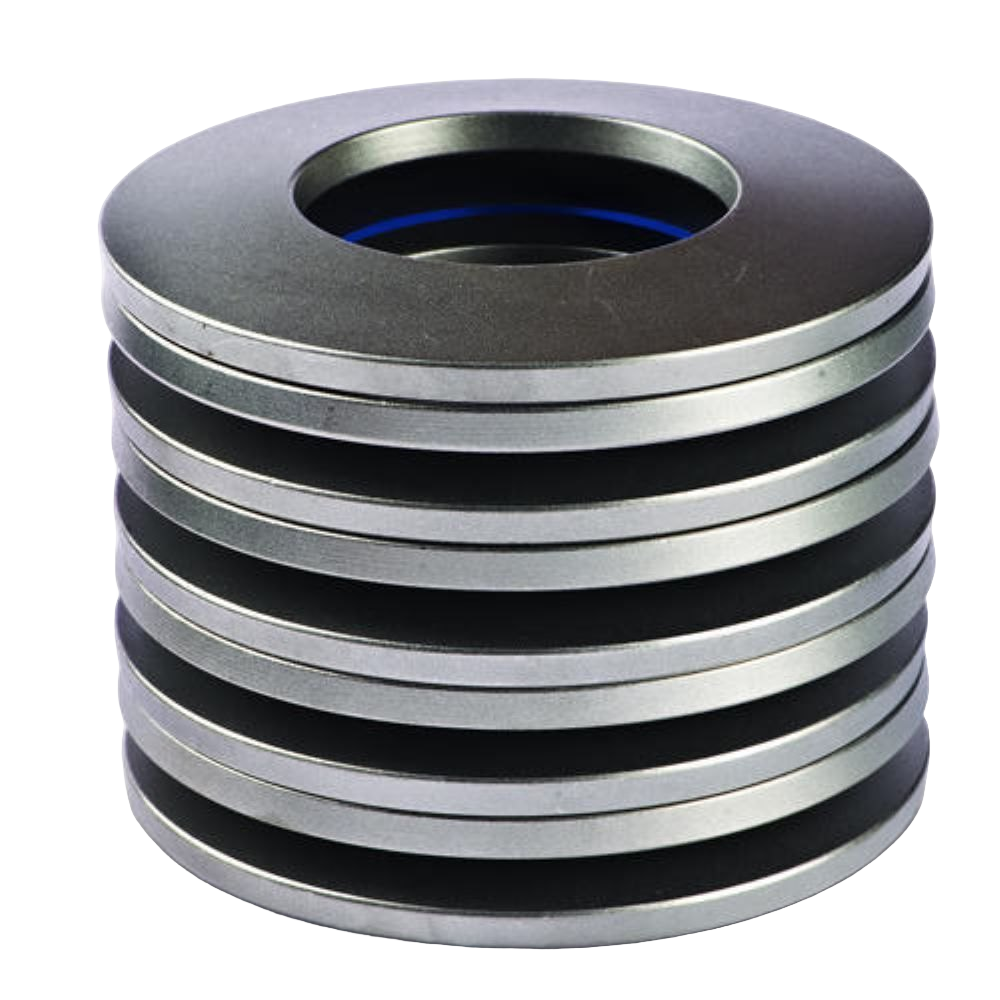
    A disc spring β€” also called a Belleville spring or Belleville washer β€” is a conical washer that deflects flat under axial load, storing energy in a much shorter travel than an equivalent coil spring, in a form that stacks in series (to multiply travel) or parallel (to multiply load) within the same bore. Himalay lists five material grades across a two-tier pattern. SS 1.4571/316Ti (the largest single grade) and Inconel 718 carry the broadest processing range β€” five and three heat treatments respectively, including hardened-and-tempered and solution-annealed options. SS 1.4571/316Ti spans all three tolerance classes (Class 1 through Class 3 high-precision); Inconel 718 is offered in Class 2 and Class 3 only, with no Class 1/commercial grade. C75S spring steel, 51CrV4/6150 alloy steel and SS 1.4310/302 stainless carry a narrower three-heat-treatment, two-tolerance-class range. All five grades span the same four represented outer diameters: 16mm, 60mm, 175mm and 400mm. The catalogue spans 960 configurations, the smallest of the springs category's five families. Edge-ground/stress-peened is this family's standard finish. Eight surface-coating options are available depending on grade, from plain and passivated stainless through zinc-nickel, mechanical galvanizing and epoxy/powder coat. Design follows DIN 2092/DIN 2093, now aligned with EN 16983 for dimensions and quality and EN 16984 for calculation β€” including stacking arrangement, load/deflection curves under series or parallel stacking, and fatigue life β€” plus IS 3322 for the Indian market. Quantitative performance data β€” spring rate, maximum working load, deflection, fatigue-cycle target, operating temperature range and minimum yield stress β€” is not published on this family pending field verification; only disc diameter and weight are confirmed figures in Himalay's data today. State material grade, disc dimensions (outer diameter, inner diameter, thickness, cone height) and your stacking arrangement (series, parallel or a combination) with your enquiry, and share your load/deflection requirement so it can be engineered against the applicable standard.
    Buyer guide

    Specifying Disc Springs: Material, Diameter and Stack Arrangement

    01

    A washer that stores energy, not a coil that stretches or compresses

    A disc (Belleville) spring is a shallow cone of spring material β€” steel, stainless or a nickel alloy β€” that flattens under axial load and springs back when the load releases. Because the working travel is the height of the cone rather than the length of a coil, a disc spring stores a given amount of energy in a much shorter axial length than an equivalent coil spring, and it can carry very high loads relative to its size. That's also why it specifies differently: a coil spring is described by wire diameter, coil count and free length; a disc spring is described by outer diameter, inner diameter, thickness and cone height β€” four dimensions on one washer, not a wire gauge and a winding count.

    02

    Stacking is the feature a coil spring doesn't have, and it's a hard specification item for this family specifically

    Individual discs stack inside a guide rod or sleeve, and how they're stacked changes what the assembly does. Stacked in series β€” cone to cone, alternating direction β€” total deflection adds while load-per-disc stays the same, giving more travel from the same footprint. Stacked in parallel β€” same orientation, face to face β€” load capacity adds while deflection stays the same, giving more force from the same travel. The two patterns combine for intermediate load/deflection combinations. This is a genuinely different buyer decision from anything in Himalay's coil-spring families β€” there's no equivalent "how do I combine several coil springs to change the load/deflection curve" question for a compression or extension spring in the same structural sense.

    03

    Five material grades split by processing range, not by size β€” every grade spans the same diameters

    SS 1.4571/316Ti, the largest single grade in the family, and Inconel 718 are offered with the broadest heat-treatment range: five and three heat treatments respectively (including hardened-and-tempered and solution-annealed, options not offered on the other three grades). Tolerance class differs between the two: SS 1.4571/316Ti spans all three classes (Class 1 through Class 3 high-precision), while Inconel 718 is offered in Class 2 and Class 3 only β€” no Class 1/commercial grade. C75S (EN 10132-4/DIN 17222 spring steel), 51CrV4/6150 (EN 10089 chrome-vanadium alloy steel) and SS 1.4310/302 (EN 10151 stainless) carry a narrower three-heat-treatment range (pre-set/cold-set, stress-relieved, shot-peened) and Class 1/Class 2 tolerance only. All five grades are listed across the same four outer diameters β€” 16mm, 60mm, 175mm and 400mm β€” so grade selection is a service-environment and precision decision, not a size-availability one.

    04

    Finish and coating follow service environment

    Edge-ground/stress-peened is the standard finish across the family. Surface treatment ranges from plain and passivated (stainless, ASTM A967) through zinc-nickel and mechanical galvanizing to phosphate-and-oil, zinc plate, black oxide and epoxy/powder coat β€” availability varies by material grade. One data note: a "custom hook/loop" end option appears against the SS 1.4571 and Inconel 718 grades in Himalay's records; a disc spring has no ends to hook, so this reads as a carried-over coil-spring field value rather than a genuine option for this family, and is not offered here.

    05

    Standards, and a size-scope flag worth reading before specifying a large-diameter disc

    DIN 2093, now aligned with EN 16983, sets dimensions, materials and quality/production tolerances, with a commonly-cited outer-diameter scope of 6mm to 250mm. This catalogue's largest represented diameter β€” 400mm β€” sits above that commonly-cited ceiling; the DB's own standard field still cites the DIN 2092/2093 family across all sizes, so treat large-diameter enquiries (175mm and 400mm OD) as needing a specific dimensional-table confirmation rather than assuming blanket DIN 2093 coverage. EN 16984 is the separate calculation standard β€” design formulae, load/deflection curves for single discs, and specifically the effect of stacking arrangement and friction on load/deflection behaviour and fatigue life. IS 3322 is the Indian national disc-spring standard, cited alongside the DIN/EN set.

    06

    What isn't published, and why

    Spring rate, maximum working load, maximum deflection, fatigue-cycle target, operating temperature range, minimum yield stress and squareness tolerance all exist in Himalay's internal data but are marked pending field verification β€” none are stated as fact here. Disc outer diameter and estimated weight per piece are the only quantitative figures confirmed today.

    From spec to RFQ

    State material grade, the four disc dimensions (outer diameter, inner diameter, thickness, cone height), tolerance class, surface finish and your intended stack arrangement (series, parallel, or combined), plus your required load, deflection and cycle life so the assembly can be engineered to DIN 2093/EN 16983/EN 16984. Share your assembly drawing or load-deflection requirement with your RFQ.

    Submit an enquiry β†’
    Technical guide

    How Disc Springs Work

    Mechanism: a cone that flattens under load instead of a wire that twists

    A disc spring is a shallow conical shell that is loaded along its own axis; it is that cone-frustum shape itself, not a coiled wire, that gives the part its spring behaviour. Loaded singly, a disc spring behaves like a very stiff, very short-travel compression spring. Stacked, the geometry changes what the assembly does in a fixed, calculable way: nesting discs in the same orientation (parallel) divides the deflection of a single disc by the number of discs at a given force, while alternating their orientation (series) multiplies deflection by that same number. That single mechanical fact is why this catalogue treats stack arrangement as a hard specification item rather than a preference: series stacking multiplies travel at constant per-disc load, parallel stacking multiplies load at constant deflection, and the two patterns combine.

    Industries served: high load, short travel, and bolted joints that must not lose tension

    Disc springs are specified into bolted-joint assemblies, power-transmission equipment and heavy-duty industrial machinery precisely because they deliver a large spring force from a very short stacking height, giving designers precision preload on a bolted joint, vibration damping in rotating equipment, and a compact fail-safe spring element where a coil spring's length would not fit. The design itself is old and broadly proven β€” a conical spring washer of this type was first patented in Dunkerque, France, in 1867 β€” which is part of why it remains a default choice wherever a designer needs high force in a confined axial space rather than a novel one. Himalay's own material split reflects the same load/environment logic, with SS 1.4571/316Ti and Inconel 718 carrying the broadest heat-treatment range for the more demanding end of that duty.

    Standards landscape: dimensions and quality on one track, calculation on another

    DIN 2093 classifies disc springs into thickness-based manufacturing groups β€” thin, cold-formed discs at one end of the range through thicker, fully machined, hot-formed discs at the other β€” and governs dimensions, production tolerances and quality; it is explicitly the dimensional counterpart to a separate calculation standard. EN 16984 is that calculation counterpart in the current standards set, covering design formulae, load/deflection curves, and specifically the effect of stacking arrangement on load, deflection and fatigue life. The split matters at the point of specification: a dimensional standard fixes what a disc spring measures and how tightly; a calculation standard predicts what a given stack will do under load. Neither substitutes for the other, which is why this family's design references both rather than treating one as sufficient on its own. Sources: [Wikipedia β€” Belleville washer](https://en.wikipedia.org/wiki/Belleville_washer); [RoyMech β€” Disc Spring Design](https://roymech.org/Useful_Tables/Springs/Springs_disc.html); [IQS Directory β€” Industrial Springs: Types & Uses](https://www.iqsdirectory.com/articles/springs/industrial-springs.html)

    Popular searches in Disc Springs

    Frequently Asked Questions

    What is a disc spring, and how is it different from a coil spring?
    Which material grade should I specify?
    What size range is available, and how does stacking work?
    What do DIN 2093/EN 16983 and EN 16984 each cover?
    Why don't you publish spring rate, load capacity or fatigue life for this family?