Home›
Springs
Frequently Asked Questions
- How do I specify a compression spring for quotation?
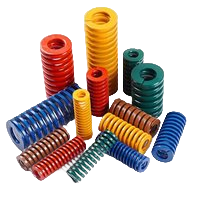
- Give us: (1) free length, (2) outside diameter (or inside diameter and wire diameter), (3) wire diameter, (4) number of active coils and total coils, (5) material, (6) end type (closed-and-ground is standard for compression springs, closed-and-not-ground for less critical), (7) load at working length, (8) working length (compressed), (9) solid length (fully compressed — should exceed working length to prevent coil clash), (10) direction of wind (right-hand default), (11) cycle life expectation, and (12) coating/finish. A drawing from your equipment's spare-parts manual or CAD model accelerates everything. If you have only the load and deflection requirement, we can engineer the spring from first principles.
- When do I need shot-peened or pre-set springs?
- Shot-peening: any cyclic-duty spring where fatigue life matters — automotive valve springs (which see 10⁸–10¹⁰ cycles over vehicle life), industrial clutch springs, diesel engine governor springs, high-pressure pump springs. Shot-peening imparts residual compressive stress at the wire surface, delaying fatigue crack initiation and extending life 2–5×. Pre-setting: springs that must maintain precise free-length dimension over time — measuring instruments, valve springs with critical preload, precision assemblies. Pre-setting yields the spring to slightly past its as-coiled free length, stabilising dimensions and eliminating long-term set under load. Both are additional processing steps — add 1–2 weeks to lead time and ~10–20% to cost.
- Can you supply springs to automotive-OEM specification?
- Yes. Several of Himalay's spring-supply partners hold IATF 16949 certification and direct tier-1/tier-2 approvals with Indian, European, and Southeast Asian automotive OEMs — including approved-vendor status for valve springs, clutch springs, suspension springs, and clutch-damper springs. PPAP documentation, cycle-life testing per OEM specification, and production-control planning are standard deliverables. For aftermarket automotive (non-OEM), specification-matched equivalents are quoted at lower cost.
- What's the typical MOQ for industrial springs?
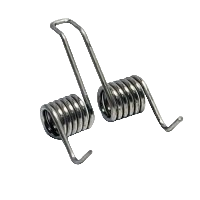
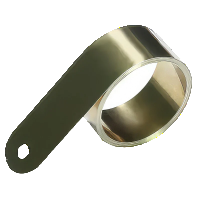
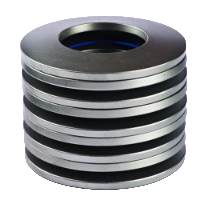
- Commodity compression and extension springs in music wire or stainless 302/316: MOQ typically 500–5,000 pieces per design depending on wire size and coiling economics. Specialty materials (chrome-silicon, Inconel, Elgiloy): 200–1,000 pieces. Disc springs (Belleville): 500–5,000 pieces per DIN 2093 specification. Leaf springs: 20–200 per design (tooling-intensive). Gas springs: 100–1,000 per design. For engineered-to-order or prototype springs, small quantities (50–200 pieces) can be quoted at a tooling-amortised higher per-piece cost.
- Can I get springs with non-magnetic or explosion-proof characteristics?
- Yes. Non-magnetic springs for MRI, vacuum, and instrumentation applications: stainless 316, Inconel X-750, Elgiloy, beryllium-copper, or phosphor-bronze springs produce low-to-zero magnetic signature. Explosion-proof (ATEX/IECEx): anti-static coating and conductive grease in grease-lubricated spring assemblies prevent static-discharge ignition — standard for springs in fuel-service equipment and explosive-atmosphere applications. For food and pharmaceutical service: 316 stainless with electropolished surface finish, FDA-compliance certification on coatings. For marine and saltwater: copper-beryllium or Monel for extreme corrosion service.
- Lead time for springs?
- Standard coil springs in music wire or stainless, with existing coiling-machine tooling: 3–5 weeks from order to FOB Mumbai. Custom-wound springs requiring new tooling setup: add 1–2 weeks. Disc springs (Belleville) in standard DIN sizes: 4–6 weeks. Leaf springs and custom-formed springs: 6–10 weeks including tooling. Gas springs: 5–8 weeks. Post-coiling heat treatment, shot-peening, and coating each add 1 week. For production-program orders with forecast, lead times for subsequent replenishment drop substantially as inventory is pre-positioned.