Why the Y shape exists
Put a pocket or a seat at 45 degrees to a pipe run and you get two things at once: the flow keeps moving in nearly a straight line, so pressure drop stays low, and the angled branch gives you a workspace, room for a screen, a seat or a plug, that a straight tee or right-angle body cannot offer as cheaply. Every family in this hub exploits that geometry.
Strainer mechanics
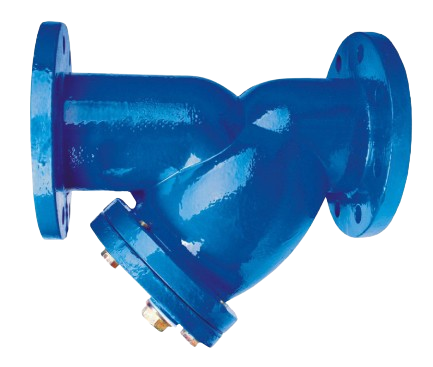
Flow enters the screen cylinder from inside and passes out through the perforations, so debris collects on the inner surface where the blowdown connection or removable cap can reach it. Capture is purely geometric: anything larger than the opening stays. The engineering trade lives in the open-area ratio: a screen with generous free area relative to pipe bore adds little resistance when clean and, as debris builds, its pressure drop rises slowly, extending the interval before cleaning. An undersized or too-fine screen chokes early, and a choked strainer either starves the pump it protects or, in the worst case, collapses and sends its own fragments downstream, which is why screens are specified in stainless and checked against differential pressure. On steam lines the pocket is mounted horizontally so it does not fill with condensate; on liquid lines it points down so debris settles into it.
Y-globe flow behaviour
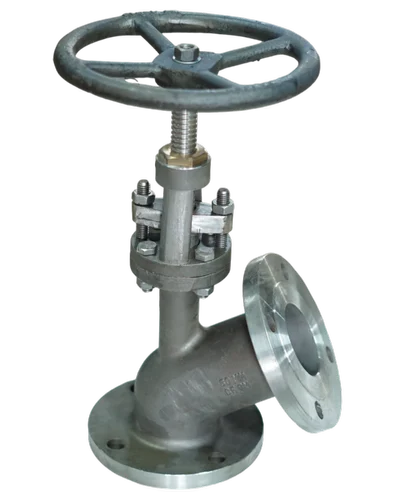
A conventional globe valve forces flow through two right angles, spending several velocity heads of pressure; the Y-pattern's inclined seat lets flow sweep past with one shallow change of direction. Throttling still happens the globe way, an annular gap between plug and seat whose area varies with stem lift, giving fine control and a seat that can be re-machined or replaced. The angled stem also lets the disc approach the seat with less lateral flow load, helping the valve shut against differential pressure. What the geometry does not change is the physics of severe throttling: flashing condensate and cavitating liquid still erode trim, so hardened facings are specified for continuous near-closed duty on hot service.
Flush-bottom logic
A vessel drained through an ordinary nozzle-and-valve arrangement keeps a cup of product standing between vessel wall and valve seat, and in batch chemistry that cup contaminates the next batch or blocks solid. A flush-bottom valve puts its seat in the plane of the vessel wall. Disc types lift the closure into the vessel, sweeping the outlet clear; ram types drive a piston downward through the seat, mechanically displacing settled cake or crystals, and jacketed versions keep meltable products liquid at the outlet. The choice between them is a statement about the product: free-draining liquids take the disc, anything that settles, cakes or freezes takes the ram.
Sampling without lying
A sample is only worth taking if it represents the batch at the moment of draw. Dead space is the enemy: any cavity between the process and the sample point holds older material that comes out first. Dead-space-free sampling valves seat flush with the wall of the line or vessel, hold no cavity, and drain or purge their passage between draws; sterile variants add steam or gas purge so the path is sanitised before and after.
The common thread
Each family removes a hiding place, for debris, for pressure loss, for stagnant product, and each is specified by describing what must not accumulate: state the debris and screen opening for strainers, the duty profile for Y-globes, the product's settling habit for flush-bottom valves, and the sample integrity requirement for sampling valves, alongside size, rating, material and ends, and the quotation will match the service.