Specialty & Sanitary Valves
Hygienic and specialized valves for food, pharma and custom process applications.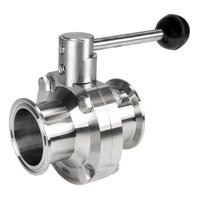

Hygienic and specialty valves from Indian manufacturers: sanitary ball, butterfly and diaphragm valves with tri-clamp ends in SS304 and SS316L, plus niche process designs.
Sourcing at a Glance
- Standards / Certifications
- ASME B16.34, API 598
Specifying Sanitary and Specialty Valves: Hygiene Class, Finish, Ends
Two groups, one habit of mind. Sanitary valves are defined by what they must not do: trap product, harbour growth, shed particles or fail a cleaning cycle. Specialty valves are defined by a duty no mainstream family serves. Both are specified by describing the application in full, which makes this hub's buying discipline different from commodity valve sourcing.
The hygienic families. Sanitary butterfly valves are the transfer-line workhorse of dairies and beverage plants: a polished disc and food-grade liner, cheap enough to install liberally, cleanable in place. Sanitary ball valves add pressure capability and a full bore for viscous or pumped products; specify cavity-filled seats where the standard ball cavity would trap product. Diaphragm valves are the high-purity choice: the elastomer or PTFE membrane isolates stem and mechanism from the product completely, the weir-pattern body drains when installed at the recommended angle, and the design tolerates repeated steam sterilisation, which is why pharmaceutical water and process systems standardise on it. Sampling, divert and tank-outlet variants extend these families for specific plant positions.
Hygienic design is in the details. Product-contact surfaces are polished to a stated maximum Ra, commonly around 0.8 micron for food and 0.4 to 0.5 for pharma, with electropolish where specified; internal geometry avoids crevices, threads and dead legs; elastomers are food-contact grades of EPDM, silicone, nitrile or PTFE chosen for the product and the cleaning chemistry, since CIP acids and caustics attack the wrong grade faster than the product does. Bioprocessing projects often follow ASME BPE conventions for surface finish and drainability; state it if your plant does.
Materials. SS304 for general food duty, SS316L wherever pharmaceuticals, chlorides or acidic products raise the corrosion stakes; certificates for material and finish should be requested with the order, and Indian stainless clusters serving dairy and pharma provide them routinely.
Connections. Tri-clamp ferrules dominate pharma and modern food plant for tool-free strip-down; DIN and SMS unions persist in dairy; weld ends give the cleanest permanent joint. State the standard and size series exactly, and order gaskets in the same elastomer decision.
The specialty side. For duties outside any family, angle-pattern drains, jacketed valves for products that solidify, diverter and changeover designs, engineered one-offs, describe the fluid, conditions, function and geometry rather than guessing a type name, and attach a sketch. Indian manufacturers with design capability quote against a described duty.
What to state in the enquiry. Product handled and its properties; cleaning regime (CIP chemistry, SIP temperatures); line size and end standard with series; internal finish Ra and whether electropolished; elastomer grade; pressure and temperature; certificates required; quantity; and for specialty items, a full application description with any drawing. Hygienic sourcing rewards the complete enquiry more than any other valve segment.
How Sanitary Valves Work
The problem is not flow, it is residue. Any competent valve stops flow. A sanitary valve must also present no place where product lingers, because a film of milk or a pocket of broth in a crevice becomes a bacterial culture between cleaning cycles, and in pharma a trace of the last batch is contamination of the next. Every design feature of hygienic valves, and most of their cost, answers this one problem.
Surface physics. Bacteria and product films anchor in surface roughness. Polishing product-contact steel to a low Ra value leaves fewer and shallower anchoring sites and lets cleaning solutions shear residue away; electropolishing goes further by smoothing microscopic peaks electrochemically and enriching the passive chromium oxide layer. This is why finish is specified numerically and certified, and why a rough weld bead inside a polished body genuinely matters: the whole flow path is only as cleanable as its roughest patch.
Geometry: crevices and dead legs. Threads, sharp corners, gasket gaps and instrument tees create spaces where circulating cleaning fluid moves too slowly to scour. Hygienic valves therefore use clamp or union connections with controlled gasket compression instead of threads, radiused internal corners, and bodies designed to drain completely by gravity, a weir diaphragm valve installed at the recommended angle empties itself, where a horizontal ball valve cavity holds a ring of product indefinitely. Cavity-filled ball seats exist precisely to occupy that ring of space.
Why the diaphragm valve rules high purity. In a diaphragm valve the flexible membrane is the only moving part the product ever touches; stem, compressor and bonnet stay on the dry side. There is no stem seal exposed to product, no packing to shed, and the sealing action, membrane pressed onto a smooth weir, has no sliding contact to generate particles. The membrane is also the sacrificial element: elastomer grades fatigue with steam cycles and flexing, so it is inspected and replaced on schedule, a maintenance model pharma prefers because the wear part is visible, cheap and product-side only.
Cleaning and sterilising in place. CIP circulates caustic, acid and rinse water at velocity and temperature through the assembled line; SIP follows with steam, commonly at 121 to 135 degrees C. The valve must tolerate the chemistry (elastomer choice), the temperature cycling (membrane and seat life), and the mechanics of cleaning, opening partially or fully so solutions reach seating surfaces. Elastomer selection is thus a three-way match between product, cleaning chemistry and temperature, and the single most frequent cause of premature sanitary valve maintenance is a gasket grade chosen for the product but not the CIP acid.
Failure modes worth knowing. Membrane fatigue and pinholing in diaphragm valves, announced by weep holes in the bonnet if the design has them; liner swelling and disc drag in butterfly valves when the elastomer and product disagree; rouging, a thin iron oxide film, in high-purity water systems, managed by material grade and periodic derouging; and gasket extrusion at clamp joints from over-tightening, which creates exactly the crevice the joint was designed to avoid. All are managed by specification and scheduled replacement rather than by heavier construction.
What this means at enquiry time. State product, cleaning chemistry and temperatures, finish requirement, elastomer grade and end standard, and the valve that arrives will clean as well as it seals, which in this segment is the entire point.
Frequently Asked Questions
- Sanitary butterfly, ball or diaphragm valve, which should I specify?
- Match the valve to the hygiene level and the fluid. Sanitary butterfly valves suit dairy and beverage transfer lines: simple, CIP-cleanable, economical. Sanitary ball valves give higher pressure and full bore for viscous products, but the ball cavity is harder to clean; use cavity-filled seats where residue matters. Diaphragm valves suit pharmaceutical and high-purity duty: the membrane isolates the mechanism from the product, the body drains fully at the correct angle, and they survive SIP steam cycles. State product, cleaning regime and pressure in the enquiry and the family follows.
- SS304 or SS316L, and what surface finish should I ask for?
- SS304 is adequate for many food and beverage products; SS316L is the default for pharmaceuticals, salty or acidic products and anywhere chloride pitting or weld corrosion is a risk, the L low-carbon grade protecting weld zones. Surface finish is specified as a maximum Ra value on product-contact surfaces: around 0.8 micron suits general food duty, 0.4 to 0.5 micron is common for pharma, with electropolishing specified where the plant standard demands it. State the Ra number and whether it applies to welds too; a polished body with rough weld beads defeats the purpose.
- What do tri-clamp and other hygienic end connections involve?
- Hygienic lines avoid threads in the product zone because threads trap residue. Tri-clamp (clamp ferrule) ends join two flared ferrules with a gasket and a hinged clamp, dismantling in seconds for inspection, the dominant pattern in pharma and widely used in food. DIN and SMS unions are round-nut hygienic couplings traditional in dairy, and weld ends give the most crevice-free permanent joint. State which standard and size series your plant uses, ferrule diameters differ between series, and specify the gasket elastomer at the same time, since it touches the product just as the valve does.
- How should I enquire about a specialty valve that no standard category fits?
- Describe the application, not a guessed type name. State the fluid and its properties (viscosity, solids, corrosivity, temperature), the pressure and flow conditions, what the valve must do (isolate, divert, sample, drain, relieve), the installation geometry, and any cleaning or certification constraints. Attach a sketch or datasheet if one exists. Indian manufacturers with engineering capability quote specialty designs against a well-described duty; they cannot quote against a name that means different things in different industries. One clear paragraph of application detail saves weeks.