Softening Agents
Source softening agents from India's verified manufacturers and exporters on Himalay. Browse the full range for industrial and export applications.
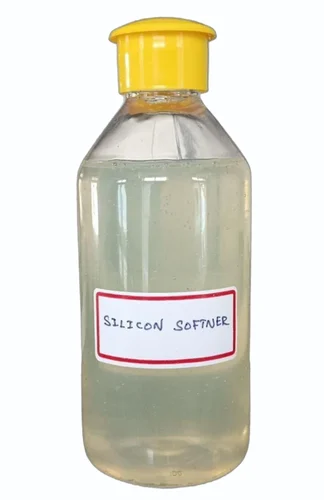
About Softening Agents
Softening agents are textile finishing auxiliaries applied after dyeing or printing to impart softness, smoothness, drape, and improved handle (the fabric's tactile feel) to woven, knitted, and nonwoven goods. They reduce inter-fibre friction and improve sewability, tear strength, and consumer appeal across cotton, polyester, blends, and technical textiles.
Grades are supplied by chemistry class and are specified for compatibility with the substrate and process: silicone softeners (amino-functional micro- and macro-emulsions) for premium softness and elasticity; non-ionic and cationic fatty-derivative softeners for general bulk softening; and hydrophilic softeners where moisture management must be retained. Buyers specify ionic character (cationic, non-ionic, anionic), active content (%), pH, and dilution/application route (exhaust or pad-mangle). Yellowing resistance and shade-change behaviour on whites and pastels are key selection parameters.
Forms are liquid emulsions and dispersions, with some flake/paste concentrates. Packaging is typically 50-200 kg HDPE drums, 1000 L IBCs for bulk users, and 25 kg carboys/cans for smaller mills, with FCL consignments standard for EU and GCC importers.
For EU buyers, REACH registration is confirmed and an Only Representative pathway coordinated where required; CLP labelling, SDS, and where requested OEKO-TEX/ZDHC-aligned eco-documentation accompany shipments, and SABER/SASO is arranged for Saudi Arabia. Himalay's verified manufacturer/exporter partners supply softening agents with CoA per batch (active content, pH, ionic character), SDS, REACH/CLP compliance coordinated for EU, GHS labelling, and SABER for Saudi Arabia handled as part of the standard order flow.