Planetary Gearboxes
Source planetary gearboxes from India's verified manufacturers and exporters on Himalay. Browse standard planetary drive, servo planetary gearbox, high torque planetary gearbox and robot planetary gearbox for industrial and export applications.
Browse Planetary Gearboxes by Type
About Planetary Gearboxes
Planetary gearboxes transmit torque through an epicyclic gear train in which a central sun gear drives several planet gears that orbit inside an internally toothed ring gear, with the planet carrier delivering the output. Because load is shared across three or more planet meshes simultaneously, planetary units achieve high torque density and a compact, coaxial (in-line) input-to-output arrangement that is difficult to match with parallel-shaft or worm designs. The reduction ratio of a single stage is set by the sun-to-ring tooth relationship and typically falls between roughly 3:1 and 10:1.
The family spans economy and precision grades. Single-stage units cover about 3:1 to 10:1; two-stage builds extend to roughly 100:1, and three-stage to several hundred to one. Output torque ranges from a few Nm in small servo frames to many thousands of Nm in heavy slew and winch drives, with per-stage efficiency commonly cited around 94-98%. Gear load capacity is generally rated to ISO 6336 or AGMA 2001/2101, gear accuracy to ISO 1328 / AGMA 2015, and enclosed-drive practice to AGMA 6010. Backlash is the dimension that most distinguishes grades: economy units run roughly 8-15 arcmin, while precision and servo grades target under 1 to 3 arcmin.
Construction usually combines case-hardened alloy-steel gears (commonly 20MnCr5 or 18CrNiMo7-6) with ground or lapped flanks, running in cast-iron or aluminium housings on rolling-element bearings (SKF/FAG-equivalent) with appropriate shaft seals. Surface treatments and reduced-backlash classes are selected by application.
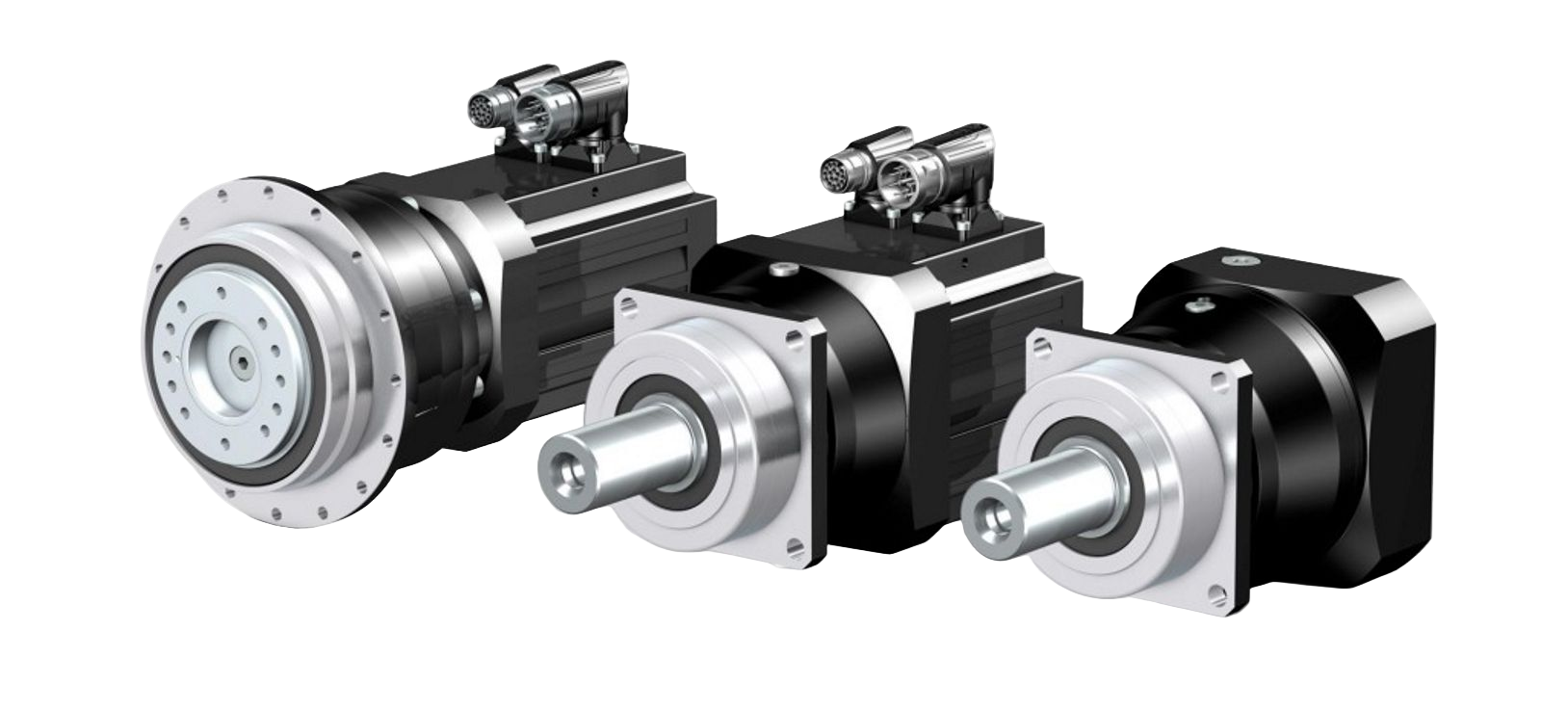
Configuration covers input options such as IEC/NEMA motor adapters, servo flanges or free input shafts; outputs as solid shaft, hollow shaft, shrink disc or flange; multiple mounting positions; and lubrication by mineral or synthetic PAO oil (ISO VG 220/320), often lifetime-filled in sealed frames. Service factor is selected per AGMA practice to suit the duty.
Himalay's MSME partners manufacture planetary gearboxes with gear-rating to AGMA/ISO 6336, ISO 9001 quality systems, load and efficiency test reports and material traceability; CE (Machinery Directive), ATEX/IECEx for hazardous areas, and SABER (Saudi Arabia) can be coordinated as part of the standard order flow.