• Homeβ€Ί
  • Wafer Check Valves
  • Homeβ€Ί
  • Valvesβ€Ί
  • Wafer Check Valves
  • Wafer Check Valves

    Source wafer check valves from India's verified manufacturers and exporters on Himalay. Browse the full range for industrial and export applications.

    Showing 1 items
    1 items
    operation type
    Wafer Disc
    body material
    CI
    SS304
    SS316
    WCB
    end connection
    Wafer
    seat material
    EPDM
    Metal
    trim material
    SS304
    Wafer Check Valves sourcing

    About Wafer Check Valves

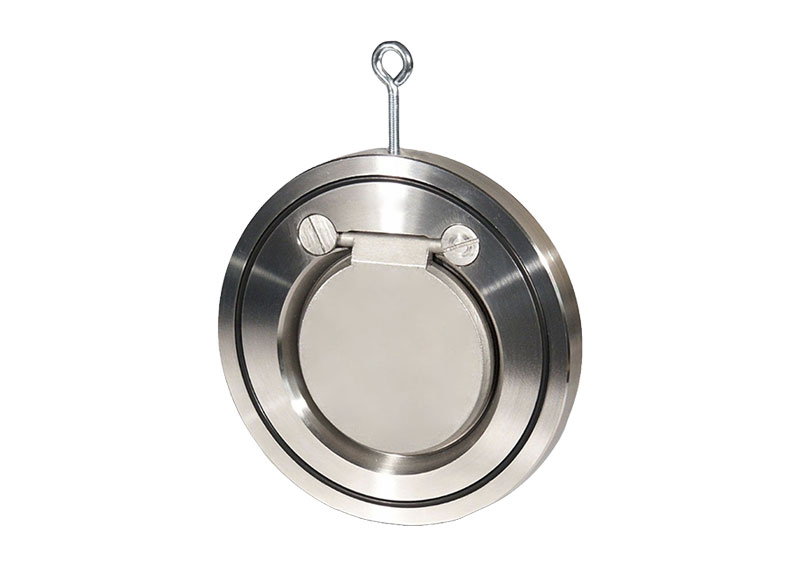
    Slim wafer check valves that clamp between pipe flanges, in single-disc and dual plate designs, DN40 to DN600, in cast iron, carbon steel and stainless with metal or resilient seats.

    A wafer check valve is defined by its body style rather than its closure: a slim ring that clamps between two pipe flanges on through-studs, with no flanges of its own. Inside, the closure may be a single spring-assisted disc, a swing flap or a pair of spring-loaded plates, so the wafer family overlaps with disc check and dual plate designs. The attraction is space and cost: face-to-face length is a fraction of a flanged swing check, weight is low, and one body pattern often suits several flange drillings. Wafer checks are used throughout building services, HVAC, water treatment, cooling circuits, pump discharge and general industry wherever a compact non-return function is needed. Indian manufacturers commonly supply cast iron and ductile iron bodies with bronze or stainless internals for water at PN10 and PN16, carbon steel and CF8M stainless bodies to ASME class 150 and 300 for process duty, and all-stainless spring disc versions for utilities and hygienic-adjacent services. Dual plate wafer valves are built to API 594, pressure-temperature ratings follow ASME B16.34, and testing is to API 598. Because the valve is trapped by the joint, it must match the flange standard, rating and gasket arrangement exactly. When enquiring, state line size, flange standard and rating, disc style, body and trim materials, seat type, service medium and temperature, mounting orientation and quantity.

    Buyer guide

    Specifying Wafer Check Valves: Disc Style, Materials and Flange Fit

    01

    What the valve is actually for

    A wafer check valve provides a non-return function in the thickness of a spacer ring: the body clamps between two pipe flanges on through-studs and seals against both with gaskets, so the valve occupies almost no face-to-face length, weighs little, and costs far less than a flanged valve of the same material, which matters most in stainless and alloy construction. It is the standard compact check for building services, HVAC, cooling water, water treatment and general pump discharge.

    02

    Closure variants and when each is chosen

    Single spring-loaded disc types close a guided central disc axially on a light spring; they are the shortest pattern, close quickly, work in any orientation, and suit clean water, air and utility services. Swing-flap types hinge one flap at the top of the ring, giving a fuller bore and some tolerance of light solids at the cost of slower, gravity-dependent closure. Dual plate types carry two sprung semicircular plates to API 594 and give the best non-slam performance for pump manifolds and larger diameters. As media get dirtier, move from disc to flap; as reversal gets faster, move to dual plate or an axial nozzle check.

    03

    Materials

    Water services take cast iron or ductile iron bodies, bronze or stainless discs, stainless springs and EPDM or NBR seats, with EN 12334 covering cast iron check valves. Process services take WCB carbon steel or CF8M stainless bodies with stainless internals, metal seats for temperature or Viton facings for chemicals, and Inconel springs where chlorides threaten. Indian foundries and machine shops supply all of these with EN 10204 3.1 certificates.

    04

    Ratings, ends and the fit question

    Ratings follow the flange system: PN10 and PN16 for iron water valves, ASME class 150 and 300 commonly for steel, with pressure-temperature ratings to ASME B16.34 and testing to API 598. Because the valve is trapped in the joint, the enquiry must fix the flange standard and drilling (ASME B16.5, EN 1092 or IS 1538), the gasket arrangement, and the pipe bore, since discs and plates swing proud of the valve face into the adjacent pipe and must clear it. A wafer valve that fits one drilling will often not centre on another.

    What to state in your enquiry

    Give line size, exact flange standard, rating and drilling, pipe schedule or bore, closure style, body, disc, spring and seat materials, applicable standards, service medium and temperature, orientation, cracking pressure if the system is gravity-fed or low-head, quantity, and inspection, painting and export packing requirements. The joint specification is the heart of a wafer valve RFQ; give it completely and the rest of the quotation follows quickly.

    Submit an enquiry β†’
    Technical guide

    How Wafer Check Valves Work

    The body principle

    A wafer check valve has no end connections of its own. The body is a machined ring, faced on both sides for gaskets, that the pipe flanges compress like a thick spacer; long studs pass outside or through the body and carry the joint load. The pipe flanges therefore do three jobs at once: they seal the joint, they locate the valve concentrically, and they react every force the valve sees, including the thrust of a hard closure. This is why the flange standard, drilling and gasket arrangement are part of the valve specification rather than a site detail, and why a wafer valve cannot simply be swapped between metric and ASME systems.

    Closure mechanisms inside the ring

    Three mechanisms share the wafer envelope. The axial spring disc holds a flat guided disc against a seat ring with a light compression spring; forward flow lifts the disc a few millimetres along its guide, and the spring returns it as flow decays, giving quick, orientation-free closure. The swing flap hangs a single plate from a hinge at the top of the ring and behaves as a short swing check, opening fully clear of the bore but relying on gravity and reverse flow to close. The dual plate mechanism folds two sprung half-discs back against a central hinge post, tracking flow continuously so the plates seat before reverse flow develops. Stroke lengths across all three are short, which is what lets the whole valve live inside a ring a few centimetres thick.

    Flow behaviour

    Short bodies mean the closure member sits close to the disturbed flow leaving pumps, elbows and reducers, so wafer checks are more sensitive to upstream turbulence than long-pattern valves; a few diameters of straight pipe upstream steadies the disc. Spring disc types carry a centre guide and seat ring in the flow and cost more head than flap types; dual plates sit between the two. All three follow the universal check valve rule: the closure must be fully open and against its stop at normal flow, because a part-open member flutters, and flutter in a short body quickly wears guides, hinge pins and springs.

    Failure modes

    The characteristic wafer failures are fit failures: a body centred off the stud circle leaves the gasket partly unsupported and weeping; a disc or plate that swings proud of the valve face strikes heavy-wall, lined or small-bore pipe and jams part-open; a gasket chosen too soft extrudes into the bore and fouls the flap. Mechanism failures mirror the parent designs: spring fatigue and corrosion in disc and dual plate types, hinge wear in flap types, elastomer seat swelling in the wrong medium.

    Orientation

    Spring-closed types work in any orientation, including vertical downward flow with suitable springs; flap types need horizontal runs or vertical upward flow.

    Why this matters for specification

    Almost every wafer check problem in service traces to the joint or to sizing, both fixed at enquiry: state the exact flange specification, pipe bore, medium, flow range and orientation, and the valve that arrives will fit, clear the pipe, and close quietly.

    Popular searches in Wafer Check Valves

    Frequently Asked Questions

    Single-disc, swing flap or dual plate inside my wafer check valve?
    How do I make sure a wafer valve actually fits my flanged joint?
    Which materials should I specify for water versus process duty?
    What should my wafer check valve RFQ include?