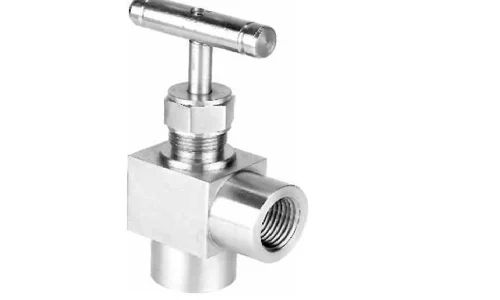
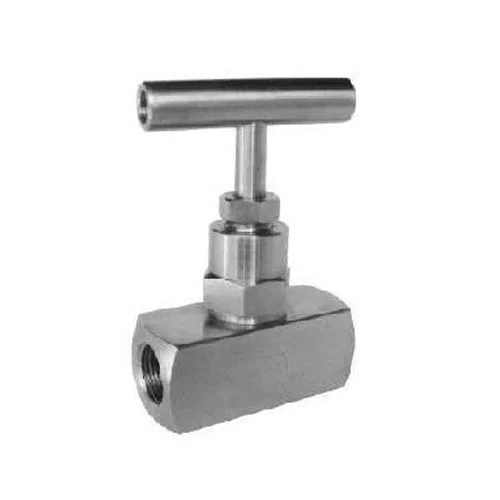
The metering mechanism
A needle valve closes by driving a long, finely tapered stem tip into a conical seat machined into the body. Because the taper is shallow, each turn of the handle changes the annular flow area between needle and seat by only a small amount, and a typical valve needs four to six full turns from shut to fully open. That is what gives the fine, repeatable adjustment a globe valve of the same size cannot match, and why needle valves are the default for gauge snubbing, purge flows and analyser sample rates.
Shut-off behaviour
Shut-off is metal-to-metal in most designs: the hardened or work-hardened stainless tip beds into the softer body seat. Tight closure needs only moderate handwheel torque; overtightening is the single most common cause of damage, because it swages the tip into the seat, tears the sealing line and makes the next closure worse. Soft-tipped stems with PEEK or PCTFE inserts give bubble-tight gas shut-off at the cost of temperature limit.
Why stem thread position matters
In a good instrument valve the stem threads are rolled, not cut, and sit above the packing, outside the wetted zone. Threads exposed to the medium corrode, gall and carry solids into the packing. Non-rotating-tip designs decouple stem rotation from the tip, so the needle presses straight into the seat without scuffing; on frequently cycled metering duties this multiplies seat life.
Flow behaviour near the seat
At small openings the valve throttles across a very small annulus, and local velocities are high. In liquid service with high differential pressure this produces wire-drawing: a fine erosion channel cut across seat and tip by cavitating flow. If the valve must hold a large pressure drop nearly closed for long periods, choose a hardened trim (Stellite-faced or 17-4 PH tip) or take the drop in two stages. In gas service the same region generates noise and can freeze up with wet gas as Joule-Thomson cooling drops the tip temperature.
Packing and temperature
PTFE packing seals with minimal friction but cold-flows; a spring-loaded or adjustable gland keeps it live. Above roughly 230 degrees C, graphite packing takes over, at the price of higher stem friction. Pressure-temperature capability is set jointly by body material and packing, which is why a 6000 psi valve at ambient may be rated far lower at 400 degrees C.
Failure modes to design out
The recurring field failures are galled stainless stem threads (specify rolled threads and anti-galling grades or lubricants), seat erosion from throttling at high differential pressure, packing leaks from thermal cycling, and cracked tips from using the valve as a hammer-shut isolation. Each traces back to a specification choice, not to manufacturing quality.