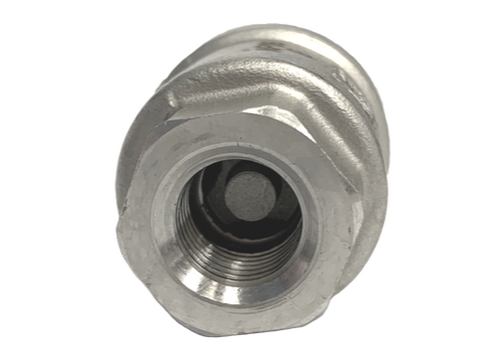
The closing problem all check valves share
When a pump trips, the liquid column decelerates, stops, and reverses. Any check valve still open when reversal begins will be slammed shut by the reverse flow, and the pressure spike that follows is proportional to the reverse velocity at the moment of seating. The entire design logic of the spring-loaded check valve is to make that reverse velocity zero: close the valve exactly as forward flow reaches zero, not after.
How the mechanism achieves it
Three features work together. The spring preloads the disc towards the seat, so disc position tracks the decaying flow instead of waiting for reversal; as flow drops, the spring wins progressively and the disc is already near the seat as flow approaches zero. The stroke is short, a fraction of the bore rather than the long arc of a swing disc, so there is little distance to travel. And the disc is light, often an annular ring in nozzle patterns, so it accelerates quickly. The result is a closure that finishes at or before flow reversal on even the fastest-decelerating systems, which is why axial checks are the reference solution on parallel pump headers, boiler feed lines and compressor discharge.
Flow behaviour and pressure recovery
A disc and spring sitting in the bore ought to cost head, and in the simple wafer disc pattern it does. The nozzle pattern solves this with shaped hydraulics: the body accelerates flow through a converging nozzle past the annular disc, then a diffuser section converts velocity back into pressure downstream. Net pressure drop of a well-designed nozzle check is comparable with far cruder valves, while the disc sees stable, attached flow that holds it firmly open without flutter.
Sizing and flutter
The spring that closes the valve also demands respect at the sizing stage. The disc must be pressed fully open against its stop at minimum operating flow; if the valve is oversized, the disc hovers mid-stroke, oscillating on the spring with every flow disturbance. Flutter wears the guide, fatigues the spring and can drum audibly. Correct practice is to size from actual minimum and normal flows, which frequently gives a valve smaller than line size, fitted between reducers.
Failure modes
Spring fatigue and corrosion dominate, which is why spring material is specified against the medium: Inconel for chlorides and sour duty, stainless elsewhere. Guide wear follows flutter from oversizing or a cracking pressure chosen too high for a low-head system. Resilient seats age in the wrong medium. A failed spring rarely blocks the valve; it degrades it into a slow, slam-prone check, so on critical machinery protection duties spring condition is an inspection item.
Orientation freedom
Because the spring, not gravity, returns the disc, these valves work horizontally, vertically upward and, with springs selected for the added load, vertically downward, an orientation almost no gravity-closed check can serve.
What this means for specification
Provide real flow data, medium, temperature and orientation. The manufacturer selects spring rate and cracking pressure from those numbers, and that selection, more than any material or rating choice, is what determines whether the valve closes silently for twenty years or flutters itself to pieces.