Why these designs exist
Every specialty ball valve is a standard quarter-turn mechanism with one added idea that defeats a specific failure: heat where the product freezes, distance where cold kills the packing, hardness where particles cut polymer, filled space where product would rot, and a shaped edge where a plain bore cannot control flow.
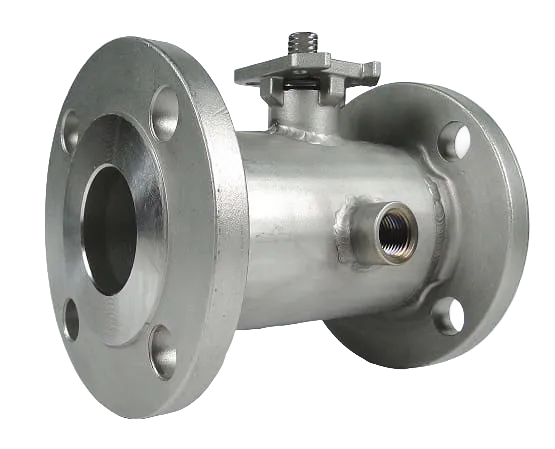
Jacketed valves and heat
Media like sulphur and bitumen are only liquid inside a narrow temperature band, and a valve is the coldest, heaviest metal mass in the line. The jacket turns the body into a heat exchanger: steam or hot oil circulates through the annulus and conducts heat through the body wall into the trim, holding every wetted surface above the melting point. Failures are thermal, not mechanical — an unjacketed flange face or a dead-legged jacket connection creates the cold spot where the product skins over, and the frozen film then shears or jams the ball at the next stroke.
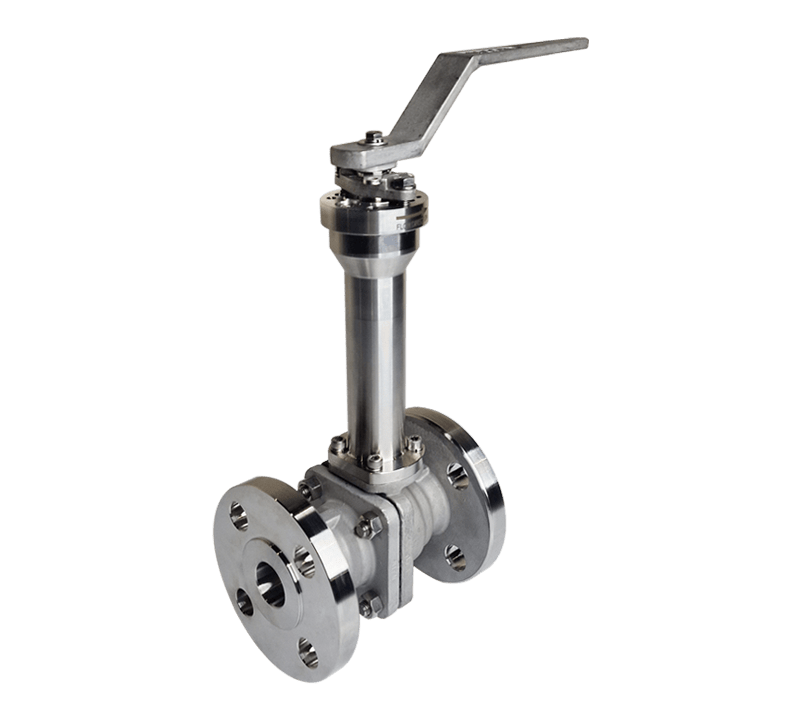
Cryogenic valves and the gas column
At minus 160 degrees C conventional packing shrinks and leaks. The extended bonnet solves this by geometry: liquid boils in the bonnet neck and a stable bubble of vapour forms under the packing, insulating it so it operates near ambient. The second cryogenic problem is trapped liquid — the closed cavity holds liquid that, warming, vaporises with a volume increase of several hundred times, generating pressures no body tolerates. A relief hole through the upstream side of the ball or a relieving upstream seat vents this to the line, which is exactly why a cryogenic ball valve seals in one direction only and must be installed with the arrow honoured.
Metal seats and hard contact
A soft seat seals by conforming; a metal seat seals by precision. Ball and seat are coated by processes such as high-velocity spraying with carbide, then lapped together until the contact band is continuous at light-band flatness. Nothing conforms, so torque is higher and tightness is a measured leakage class, but nothing melts, extrudes or embeds either: particles are crushed or swept across a surface harder than they are, and temperature capability is set by the base metal and coating rather than a polymer.
Cavity-filled seats
In a standard valve the cavity around the closed ball holds a ring of stagnant product. In sterile or polymer duty that ring cures, degrades or breeds. Cavity-filled designs extend the seat material to occupy that space, leaving the ball rotating in near-full contact with polymer. The trade-offs are higher torque and a seat that now sees every thermal excursion of the process, which is why filler material choice matters as much as wetted metallurgy.
V-port throttling
Rotating a V-shaped edge across the seat bore opens a triangular window whose area grows non-linearly, approximating an equal-percentage characteristic. The sharp edge shears fibres, and flow stays attached to a defined orifice, giving stable control. Concentrated velocity is the cost: at high pressure drop the jet cavitates and erodes the downstream seat and body, so pressure-drop staging and material choice decide service life.
Common thread
Each mechanism works only if the service data behind it is real — melting point, minimum temperature, particle hardness, batch sensitivity, pressure-drop cases. Put those numbers in the enquiry and the design does the rest.