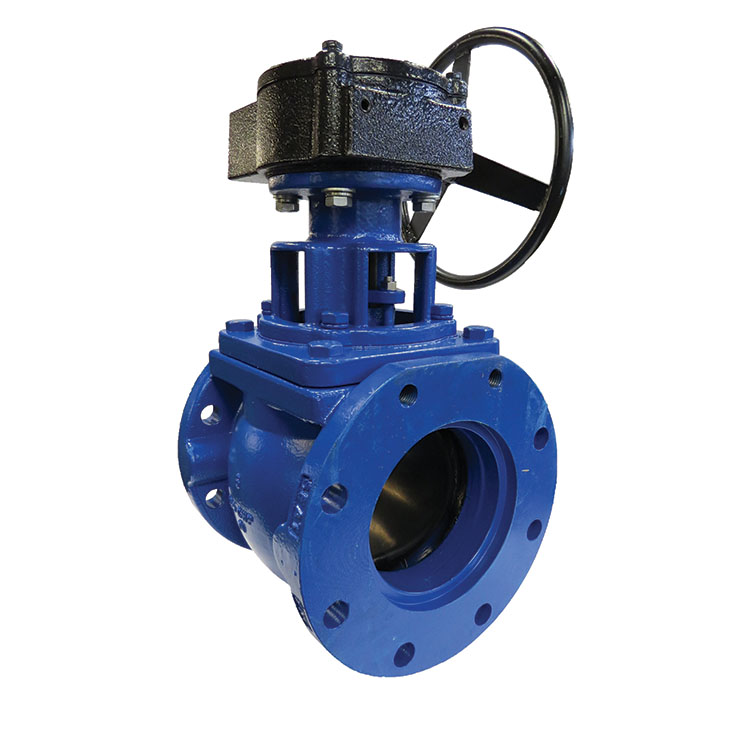
Mechanism: a full-bore plug that rotates ninety degrees and seals on contact rather than at two separate seats
A plug valve's core is a cylindrical or conical plug with one or more passageways bored straight through it — "the plugs in plug valves have one or more hollow passageways going sideways through the plug, so that fluid can flow through the plug when the valve is open." Turning the stem swings that passage in or out of line with the body ports: "the plug is rotated a fourth of a full turn to change from open to shut positions," which is what makes the design a quarter-turn valve. The pressure boundary is simpler than a globe or gate valve's, too — "plug valves usually do not have bonnets," with the stem and plug top largely exposed rather than enclosed under a separate bonnet joint. Himalay's listed range builds on that same mechanism in two sealing variants: PTFE-sleeved, where a liner does the sealing work, and lubricated, where injected sealant maintains the seal between plug and body.
Industries served: wherever solids-bearing or abrasive flow needs a full-contact shutoff
A plug's full face bearing against the body, rather than a ball touching two narrow seat rings, is what puts the design to work "extensively... in pump stations, wastewater treatment plants, lift stations and collections systems and in water treatment plants and distribution networks." The same trade-publication source reports the valves "work well handling abrasive slurries, viscous chemicals and other challenging fluids" across "chemical processing, pulp and paper and food and beverage production," and that "in environments such as power plants and mining operations, [they] deliver high performance under demanding pressures and abrasive conditions." These are general usage patterns reported for the plug-valve design family, not a record of this catalogue's own sales mix.
Standards landscape: a petroleum-industry design standard, paired with a separate ratings code
API 599 "specifies the requirements for quarter-turn metal plug valves, including the lift plug type, for petroleum, petrochemical, and industrial applications," covering steel, nickel-base and other alloy plug valves with flanged or butt-welding ends from DN15 to DN900, plus "lubricated and non-lubricated plug valves that have two-way coaxial ports" — three-way and four-way designs are explicitly excluded from its scope. The pressure-temperature ratings behind each class come from a second document: ASME B16.34 "covers pressure-temperature ratings, dimensions, tolerances, materials, nondestructive examination requirements, testing, and marking" for flanged, threaded and welding-end valves in steel and alloy construction, and is written to be "used in conjunction with equipment described in other volumes of the ASME B16 Series." Between the two, API 599 fixes what the valve is and how it is built; ASME B16.34 fixes what pressure and temperature it is rated to hold. Sources: [Wikipedia — Plug valve](https://en.wikipedia.org/wiki/Plug_valve); [Valve Magazine — The Eccentric Plug Valve](https://valvemagazine.com/articles/the-eccentric-plug-valve/); [BSB Edge — API STD 599:2025 scope](https://www.bsbedge.com/standard/metal-plug-valves-flanged-threaded-and-welding-ends-api-std-599-2025/API-STD-599-2025); [ASME — B16.34 Valves, Flanged, Threaded and Welding End](https://www.asme.org/codes-standards/find-codes-standards/b16-34-valves-flanged-threaded-welding-end)