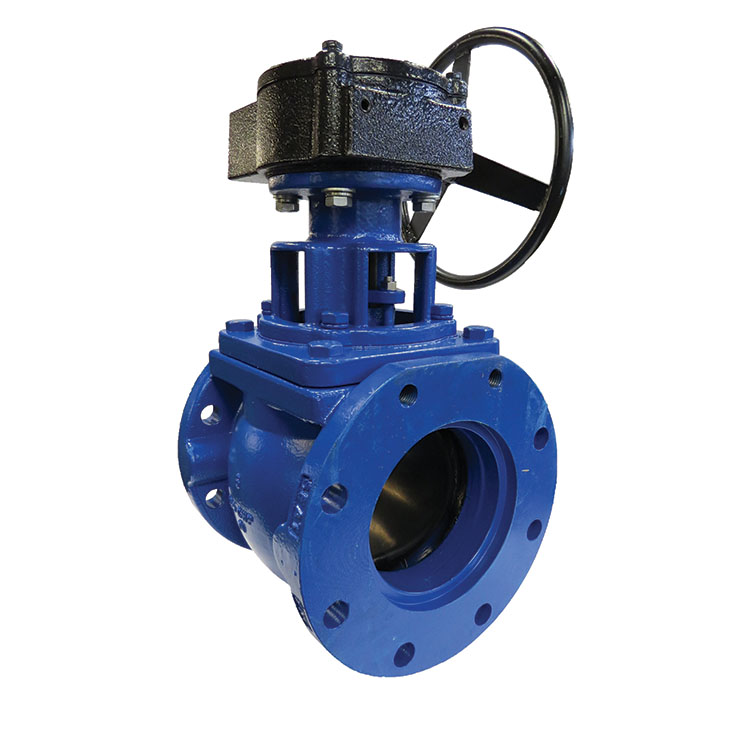
The eccentric action
The closure member is roughly a half plug, a segment of a cylinder or sphere carried on shaft bearings whose axis is offset from both the seat centre and the plug face. Rotating the shaft a quarter turn swings the face through an arc that only meets the raised seat in the last few degrees of travel, where the eccentric geometry converts shaft torque into a camming force that presses the facing into the seat. During the rest of the stroke the face travels clear of the body and touches nothing.
Why that geometry earns its keep
Sliding a resilient seal across a seat in gritty fluid grinds it away; the eccentric plug avoids sliding contact almost entirely, so the rubber facing lasts in sewage and slurry. The camming action also means seating force rises as the operator pulls the plug home, and the valve compensates automatically for facing wear, since the plug simply cams a fraction further before it seals.
Open-position behaviour
Open, the plug rests up out of the waterway, leaving an unobstructed port of about 80 to 100 percent of pipe area depending on the pattern. Solids, rags and stringy material pass without hanging up because there is no downstream cavity and no shaft exposed across the bore, and headloss stays modest. This clear waterway is also why the type throttles better than most seated valves in dirty liquids: the vulnerable seal surfaces are parked out of the erosive flow at every intermediate position.
Direct versus reverse seating
With pressure on the shaft side of the plug, the differential presses the plug onto the seat and adds to the cam force; this is the direct seating condition at which the full rating applies. Pressured from the seat side, the fluid tries to lift the plug off, and holding capability drops, which is why orientation against the sustained pressure source, the pump or reservoir side, is part of correct specification and installation rather than an afterthought.
Bearings and shaft seals
The shaft runs in permanently lubricated bearings at both ends, sealed against grit, and multiple shaft seals keep sewage out of the gearing. Bearing protection is a genuine quality differentiator between makes, since grit that reaches the bearings makes torque climb until the valve becomes unserviceable in its chamber.
Failure modes
The recurring problems are seat corrosion where the nickel overlay was omitted or applied thin, facing damage from holding pressure in the reverse direction beyond the design limit, torque growth from grit entering the bearings, and gear damage from forcing a stuck valve. All of these are specification and installation issues more than design faults, which is why the enquiry detail matters.
Why detail matters
Port area sets solids passage and headloss, seat overlay sets corrosion life, facing rubber sets chemical compatibility, seating direction sets shutoff capability, and operator sizing sets serviceability in the chamber. An enquiry covering all five lets the manufacturer supply a valve that stays maintainable for decades in wastewater service.