• Home
  • Needle Valves
  • Needle Valves

    Source needle valves from India's verified manufacturers and exporters on Himalay. Browse standard needle valves and high pressure needle valves for industrial and export applications.

    Showing 2 items
    2 items
    Subcategories
    Standard Needle Valves
    High Pressure Needle Valves
    operation type
    Handwheel
    body material
    Brass
    SS304
    SS316
    end connection
    NPT
    Threaded
    seat material
    Metal
    PTFE
    trim material
    SS304
    SS316
    Needle Valves sourcing

    About Needle Valves

    Instrumentation needle valves across 120 listed configurations — straight and angle pattern, DN6 to DN25, rated 6000 to 10000 psi, in SS316, SS304 and brass bar stock.

    Needle valves close with a tapered, pointed stem that seats into a small conical orifice — a geometry that gives fine, repeatable control over very small flow rates at high pressure, which is why the family is standard on instrumentation, sampling and gauge-isolation lines rather than on general process piping. Himalay lists needle valves in two body patterns: straight, where inlet and outlet are in line, and angle, where the outlet turns 90° from the inlet — useful for tight panel or manifold layouts. The catalogue spans 120 configurations from DN6 to DN25, at 6000 or 10000 psi. This is the second-smallest catalogue in the valves category by SKU count — only Instrument Manifolds (96) is smaller — reflecting a genuinely narrow product envelope rather than incomplete listing. Bodies are machined from SS316, SS304 or brass bar stock. Trim is an integral hardened stem tip; seats are metal-seated. End connections are threaded NPT, female-by-female or male-by-female. Operation is manual T-bar handle throughout the range. Design follows MSS SP-99, the instrument-valve standard, with ASME B1.20.1 governing the NPT thread form. State medium, working pressure, connection size and body pattern in your enquiry.

    Buyer guide

    Specifying Needle Valves: Pattern, Pressure Class and Body Material

    01

    Fine control, not flow capacity

    A needle valve's tapered stem closes gradually into a small conical orifice, giving a degree of flow-rate resolution that a ball or gate valve — designed to open a full bore quickly — cannot match. That is the entire reason the family exists: instrument bleed lines, sample points, gauge isolation and calibration duty need precise, repeatable small-flow control far more than they need throughput.

    02

    Pattern

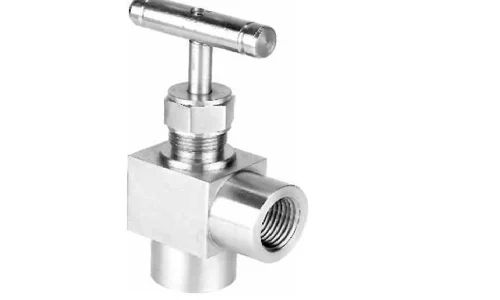
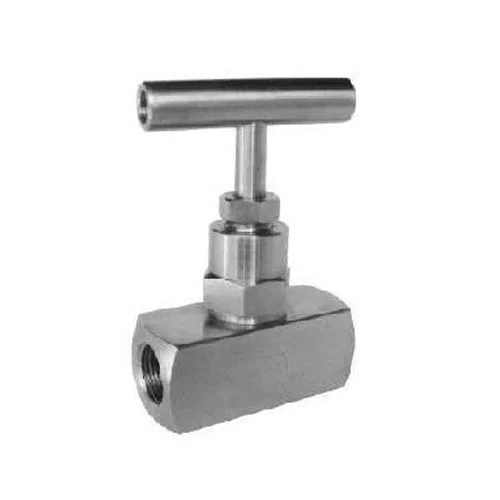
    Straight pattern keeps the flow path in line, the default absent a specific layout constraint. Angle pattern turns the outlet 90°, which is common wherever panel or manifold space is tight and a straight run would require an extra elbow fitting.

    03

    Size and pressure

    DN6 to DN25 (⅛" to 1") across 120 configurations, at 6000 or 10000 psi. This is the second-smallest catalogue in the entire valves category — only Instrument Manifolds (96 SKUs) is smaller — needle valves occupy a genuinely narrow product envelope, yet independent market reference material for this category is unusually extensive relative to its catalogue size — outside documentation exceeds what's in Himalay's own 120-SKU listing.

    04

    Why the pressure ratings run so high at such small bore

    Instrument and sampling lines commonly tap directly off high-pressure hydraulic, gas-sampling or well-testing systems, and at DN6–DN25 a solid bar-stock body can economically hold 6000–10000 psi in a way a cast body of the same bore could not. This is also why needle-valve bodies are machined from bar stock rather than cast — bar stock is generally favoured over casting at this bore-to-pressure ratio to minimise porosity risk.

    05

    Materials

    SS316 bar stock is the general instrumentation standard, giving corrosion resistance across most process media. SS304 serves less aggressive service at lower cost. Brass suits air, water and non-corrosive utility instrumentation where the cost saving matters and the medium allows it. Trim is an integral hardened stem tip on all listed configurations — the tip itself is the sealing element, machined into the stem rather than fitted as a separate part, which is what gives the fine, repeatable seating this family is specified for.

    06

    Standards

    MSS SP-99 governs instrument valves — needle, packless, ball, plug, check and manifold types — for steel and alloy construction at NPS 2 and below, rated to 15,000 psi at 100°F. ASME B1.20.1 governs the NPT thread form on threaded-end valves.

    07

    Conformity

    CE for the EU, SABER for Saudi Arabia, ECAS for the UAE, EN 10204 3.1 certificates as the EU procurement baseline.

    From spec to RFQ

    State the tap-off system pressure, medium, required flow-control resolution, connection type, body pattern and material, and destination market. Share the instrument line list with your RFQ and the valve is matched against the catalogue directly.

    Submit an enquiry →
    Technical guide

    How Needle Valves Work

    Mechanism: a tapered plunger closing gradually into a matched conical seat

    "A needle valve has a relatively small orifice with a long, tapered seat, and a needle-shaped plunger on the end of a screw, which exactly fits the seat." Turning the screw retracts or advances that plunger, and "as the screw is turned and the plunger retracted, flow between the seat and the plunger is possible; however, until the plunger is completely retracted, the fluid flow is significantly impeded" — the seal only fully releases at the very end of the stroke. The fine-threaded screw is what gives the valve its resolution: "since it takes many turns of the fine-threaded screw to retract the plunger, precise regulation of the flow rate is easily possible" — a geometry a quarter-turn ball valve or a shorter-travel globe valve cannot reproduce at the same bore.

    Industries served: protecting instruments from surge, and metering flow too small for a general-purpose valve

    "All field analog instruments are fitted with a needle valve to control flow entry, where sudden surges of fluid under pressure can damage the instruments" — the valve's job on an instrument line is as much protective as it is about flow-setting. The same fine-throttling geometry is specified "in all industries for controlling and metering fluid applications such as steam, air, gas, oil, water, or other non-viscous liquids," and at sample points in piping "where the flow must stop gradually and... precise adjustments of flow are required." Outside process plant, the same geometry shows up wherever a small, steady flow has to be dialled in and held — Wikipedia cites "vacuum systems, when a precise control of gas flow is required, at low pressure, such as when filling gas-filled vacuum tubes, gas lasers," and pressure-gauge shutoff duty. That range, instrument protection at one end and precision metering at the other, is consistent with Himalay's own catalogue sitting almost entirely in threaded, bar-stock, high-pressure configurations rather than larger flanged process sizes.

    Standards landscape: an instrument-valve design standard, plus the thread standard that governs how it connects

    MSS SP-99 governs instrument valves — needle, packless, ball, plug, check and manifold types — for steel and alloy construction at NPS 2 and below, rated to 15,000 psi at 100°F. ASME B1.20.1 sits alongside it for the threaded-end connections: it is "the foundational Standard for NPT, NPSC, NPSM, and NPSL pipe threads," covering "dimensions and gaging of the world's most common pipe threads," used, in ASME's own framing, in everything "from critical applications demanding robustness and precision to common plumbing and hardware." On a needle valve, thread dimension and gaging matter directly: a threaded NPT connection is a tapered, sealant-dependent joint rather than a parallel thread, so gaging tolerance affects whether the joint holds at the pressures this family is rated to. Sources: [Wikipedia — Needle valve](https://en.wikipedia.org/wiki/Needle_valve); [Hardhat Engineer — Needle Valve: A Complete Guide for Engineer](https://hardhatengineer.com/needle-valve/); [ASME — B1.20.1 Pipe Threads, General Purpose, Inch](https://www.asme.org/codes-standards/find-codes-standards/b1201-pipe-threads-general-purpose-inch)
    Popular searches in Needle Valves

    Frequently Asked Questions

    Straight or angle pattern — which needle valve should I specify?
    Why use a needle valve instead of a ball or globe valve on an instrument line?
    Why are these valves rated to 6000 or 10000 psi at such small sizes?
    What conformity documentation applies for EU, Saudi and UAE imports?