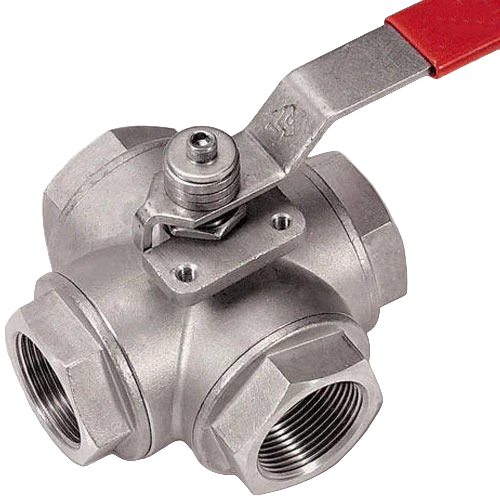
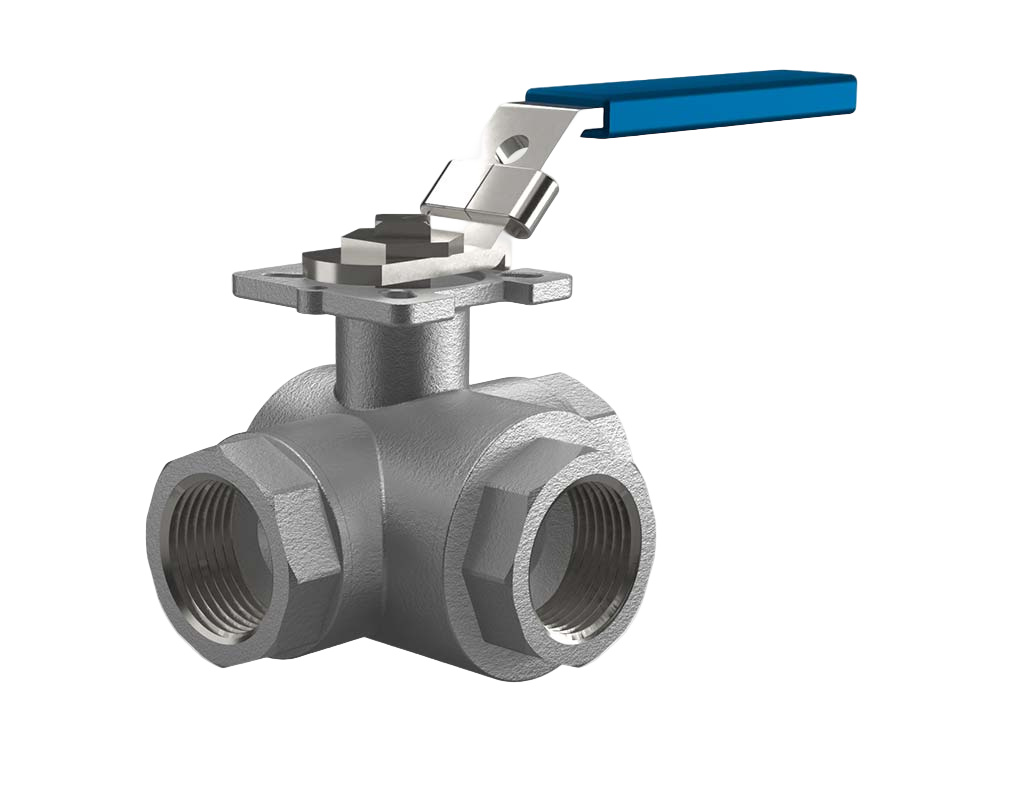
Port geometry
A multiport valve is an ordinary ball valve with a differently drilled ball. An L-port ball has a single passage turned through 90 degrees; a T-port ball has three openings meeting at the centre; four-way balls carry two separate passages or a cross. The body provides three or four seat bores at 90 degree spacing, and rotating the ball maps its internal passage onto different combinations of those bores. Everything else — stem, seats, packing — behaves as in a two-way valve.
How the L-port diverts
With the common port at the bottom or side, a 90 degree turn swings the passage from the left outlet to the right one. The leg not in use faces solid ball surface backed by a seat, so it is positively closed. Turned to an intermediate 90 degree station in a 180 degree design, both outlets can face solid ball and the valve is fully shut. This makes the L-port a selector and an isolator in one.
How the T-port mixes and splits
The tee passage can bridge any two adjacent ports or all three at once. That gives straight-through flow, divert-to-branch, or full mixing, but there is no rotation at which all ports see solid ball; a T-port valve is a router, not an isolator, and specifications that assume it will block everything are the most common source of disappointment with this product.
Transition states
As the ball rotates between stations, edges of the passage sweep across the seat bores. Depending on drilling, ports are either momentarily interconnected, which can cross-contaminate two products or briefly backfeed a header, or momentarily all restricted, which can dead-head a running pump for a fraction of a second. On slow gear or actuated operation that fraction becomes seconds. Which behaviour the drilling gives, and whether it is acceptable, should be checked against the process rather than discovered at commissioning.
Seats and cavity behaviour
Most multiport valves are floating designs, so seat loading changes with which port is pressurised: the ball is pushed off the pressurised port onto the seats opposite. In two-seat designs some positions leave the cavity and an idle port in communication, so residual product can sit in the cavity and re-enter the stream on changeover. Four-seat designs close the cavity off at each bore, improving hygiene and shut-off at the price of roughly doubled seat friction.
Torque and wear
With more seats engaged and a larger wetted seat area, breakaway torque runs higher than a two-way valve of the same size, and the seat at the common port sees flow in every position, so it wears first. Frequent changeover duty justifies reinforced seats.
Failure modes
The recurring ones are stops set to the wrong quadrant so the valve routes flow incorrectly while the handle looks right, seat wear at the common port, trapped product in the cavity, and T-ports installed where isolation was needed. All four are avoided at specification time: fix the flow matrix, mark the positions on the valve, and state the sealing duty per position in the enquiry.