Lag Screw
Source lag screw from India's verified manufacturers and exporters on Himalay. Browse the full range for industrial and export applications.
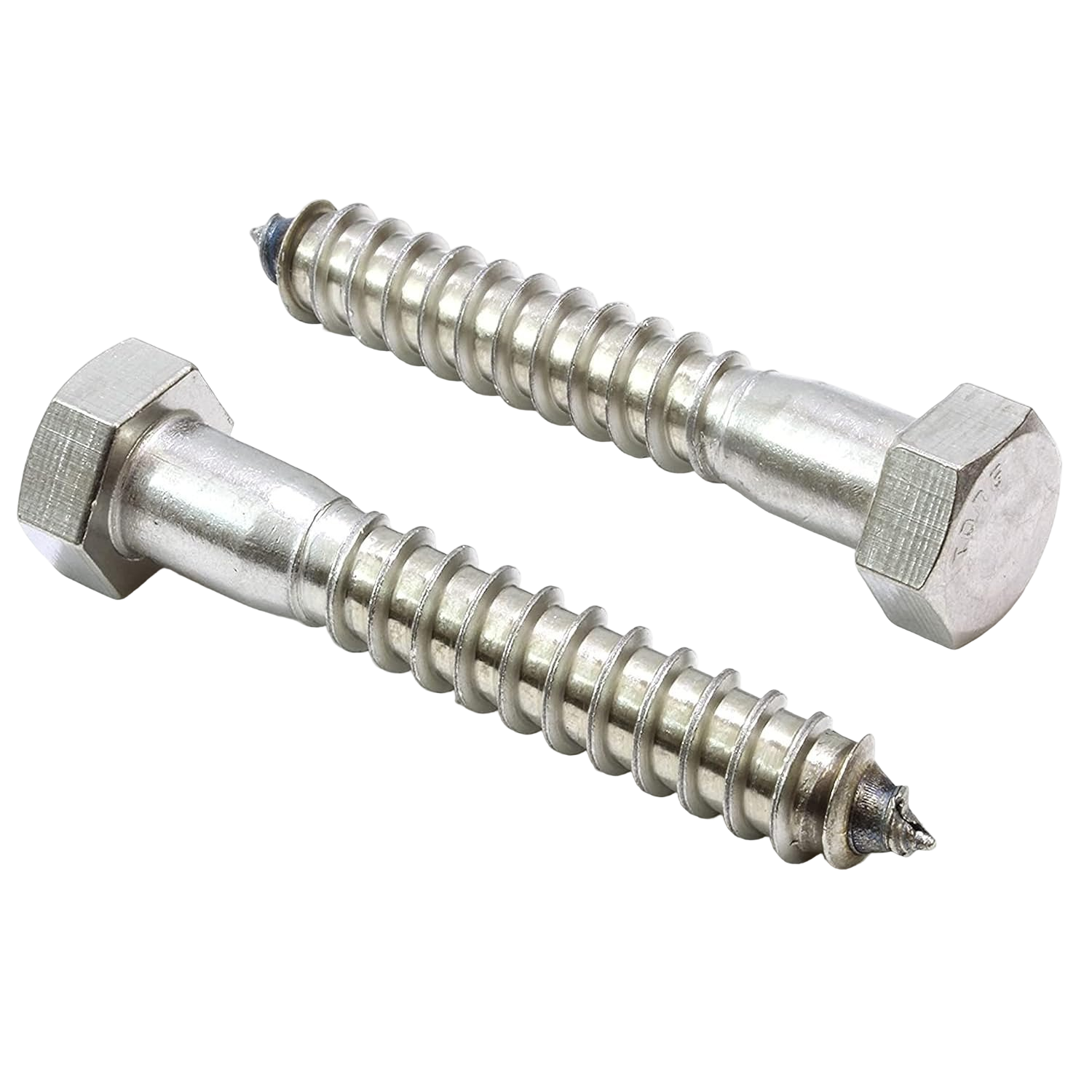
About Lag Screw
Lag screws — also called lag bolts or coach screws — are heavy-duty self-tapping fasteners with a coarse, sharp-pointed thread and a square or hex head driven with a wrench rather than a screwdriver. They are used to join heavy timber to timber, fix metal brackets and ledgers to wood, and anchor into concrete or masonry when paired with an expansion shield. The coarse thread and large shank give high shear and withdrawal capacity, which is why lag screws are common in structural carpentry, decking, mounting and machinery anchoring. Dimensionally, square and hex lag screws are widely produced to ASME B18.2.1, typically from about 1/4" to 3/4" diameter and 1" to 16" in length, in full-body or reduced-diameter forms; metric coach-screw equivalents follow DIN 571. A pilot hole is generally recommended in dense timber to prevent splitting and control drive torque. Base material is usually medium-carbon steel, with grade and any heat treatment set by the load case; corrosion protection ranges from zinc plating for interior use through hot-dip galvanising (ASTM F2329) for exterior and treated-timber contact, with stainless A2/A4 where marine or chloride exposure applies. On the configuration side, the controlling variables are diameter and length for the required embedment, thread coarseness for the timber density, and the recommended pilot-hole size that limits splitting and drive torque; head form (hex or square) follows the driving method and clearance. Manufacturers generally verify dimensions, hardness and any proof load on a sampling basis. Where specified, Himalay coordinates material traceability and mechanical certificates (tensile and proof load where applicable), salt-spray corrosion data, coating-thickness records and RoHS/REACH declarations, with CE-route documentation arranged where the destination market requires it, coordinated as part of the standard order flow.