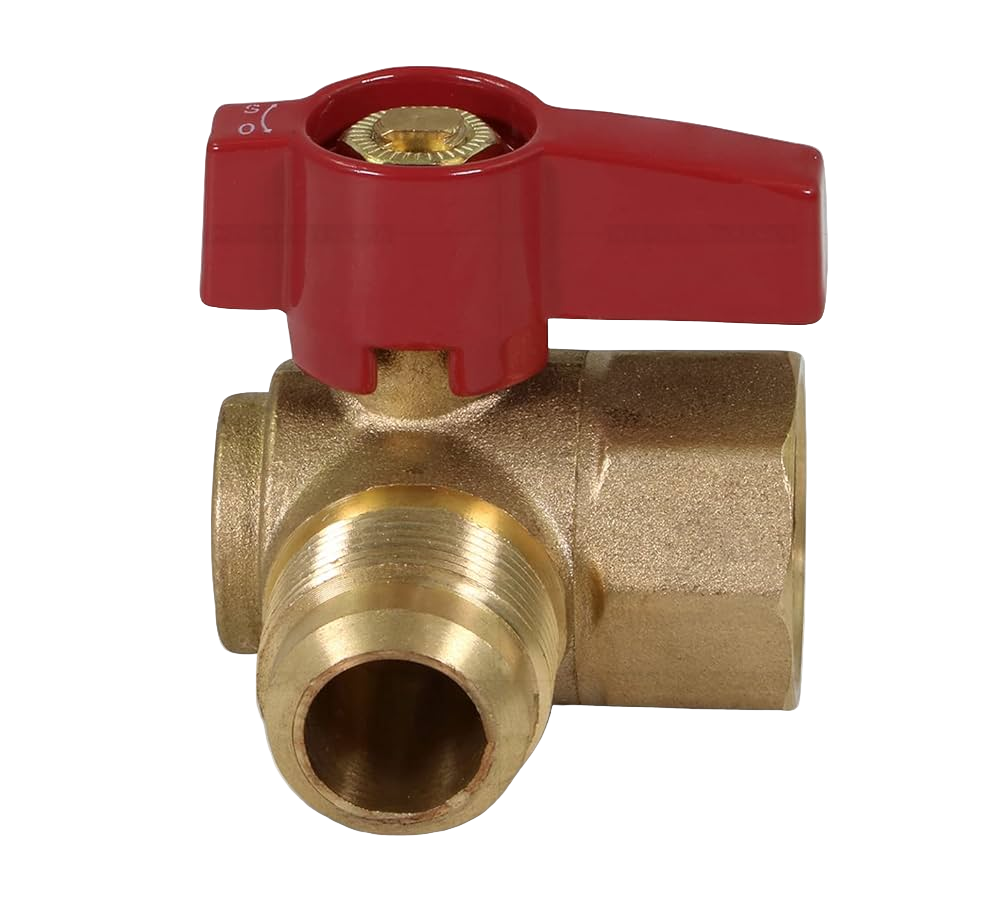
Sealing gas is harder than sealing water
Gas molecules pass leak paths that liquid surface tension would bridge, and an acceptable leak is effectively zero. So gas valve design concentrates on seal architecture: polished balls lapped into resilient PTFE or nylon seats, double O-ring stem seals, and body joints that are either welded, gasketed with controlled bolt torque, or sealed with O-rings rather than relying on thread sealant alone. Test regimes reflect this — EN 331 requires internal and external tightness testing with air at both low pressure, where soft seats seal least well, and elevated pressure, because a seat that seals at 6 bar can leak at 20 mbar.
The floating ball principle
In the common floating-ball valve, line pressure pushes the ball downstream onto the downstream seat, so sealing force rises with pressure. At building gas pressures this force is small, which is why seat preload from body assembly matters and why EN 331 valves are endurance-cycled: the seat must keep sealing at millibar pressures after thousands of operations. Trunnion-mounted balls, used on larger industrial and API 6D pipeline valves, fix the ball on bearings and let spring-energised seats float against it, keeping torque manageable and enabling double block and bleed — the cavity between two sealing seats can be vented to prove isolation before maintenance, a core gas-industry safety practice.
Fire-safe design
In a fire, PTFE seats melt. A fire-safe valve provides a secondary metal-to-metal seat that the ball contacts once the polymer is gone, plus graphite stem packing and body gaskets, limiting leakage during and after the fire. Anti-static design adds a spring-loaded contact between ball, stem and body so operating the valve cannot generate an incendive spark inside a gas-filled cavity. Both features are cheap at purchase and impossible to retrofit; industrial gas train specifications should include them by default.
Non-return and excess-flow behaviour
Manifold non-return valves hold a spring-loaded poppet against a seat; forward gas flow lifts it, reverse flow plus spring force closes it, protecting an LPG cylinder bank from back-feeding. Excess-flow check valves stay open in normal service but snap shut when flow exceeds a set rate, as happens when a downstream hose shears — the spring is calibrated so normal peak demand does not trip it, which is why stating true maximum flow in the enquiry matters.
Failure modes
The recurring field problems are seat swell or extrusion from unsuitable elastomers in LPG liquid phase, stem leakage after years of unoperated service, thread joints sealed with the wrong compound weeping at low pressure, and handles removed or forced past stops. Specification answers: name the gas and phase so seat and seal compounds are chosen correctly, prefer valves with adjustable or double stem seals, buy flanged or O-ring-sealed bodies at larger sizes, and order locking handles where unauthorised operation is a risk.
What testing to expect
Industrial valves are shell and seat tested per API 598, commonly with air seat testing for gas duty; EN 331 valves carry type-test backed production tightness tests. Ask for test certificates by serial or batch number, and for PESO-context supplies, confirm the documentation package before ordering.