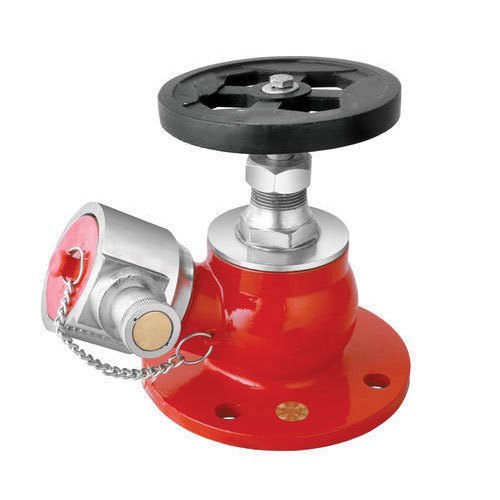
A globe valve tuned for fire duty
Internally a landing valve is a screw-down globe valve: a rising or non-rising spindle drives a disc, faced with a renewable rubber seat ring, down onto a machined body seat that stands proud of the flow path. Turning the handwheel anticlockwise lifts the disc and admits main pressure to the outlet. The globe arrangement is chosen deliberately — it seals drop-tight against standing pressure, throttles predictably while the hose line is charged, and its seat is renewable at the landing without cutting the riser.
Flow path and pressure loss
Water entering the DN80 inlet must turn toward the 63 mm outlet. In the oblique pattern the turn is shallow, so the valve passes fire-flow rates of 900 litres per minute and more with modest head loss; the right-angle pattern costs more pressure at the same flow. In tall wet risers this difference feeds directly into pump sizing and residual pressure at the topmost landing, which is why hydraulic calculations should use the manufacturer's actual loss data rather than generic globe-valve coefficients.
Controlling outlet pressure
On lower floors of a high-rise, static main pressure can exceed what a hose crew can safely hold. Pressure-regulating landing valves limit outlet pressure either with a factory-set orifice plate or with a spring-balanced disc that throttles automatically as inlet pressure rises. If your riser design pressure exceeds roughly 7 bar at any landing, say so in the enquiry so the manufacturer can offer the regulating version and set it for the floor-by-floor pressures.
Why the coupling matters
The 63 mm instantaneous female coupling accepts the male hose coupling with a quarter-turn spring-lock action, so a crew connects in seconds with gloved hands. Coupling dimensions must match the hose couplings the local brigade carries; mixing IS-pattern and other national patterns on one site is a real interoperability hazard, which is why the coupling standard belongs in the purchase specification, not left to the supplier.
Failure modes in service
Landing valves stand closed and pressurised for years, so the classic failures are a spindle seized by dezincification or scale, a rubber seat ring hardened and cracked with age, a lost blank cap letting the outlet thread corrode, and weeping past the gland after the first operation in a decade. Gunmetal and stainless construction, a greased stainless spindle, replaceable seat rings and an accessible gland are the design answers; annual operation and seat inspection are the maintenance answers. Buyers should ask how the seat ring is retained and whether spares are available separately.
Testing
Each valve receives a hydrostatic body test above rated working pressure and a seat leakage test before dispatch; IS 5290 defines the levels for compliant valves, and reputable Indian manufacturers supply test certificates and accept witness inspection. For export orders, confirm marking, certification language and packing that protects the machined coupling faces in transit.