• Homeβ€Ί
  • End Connection Ball Valves
  • Homeβ€Ί
  • Valvesβ€Ί
  • End Connection Ball Valves
  • End Connection Ball Valves

    Source end connection ball valves from India's verified manufacturers and exporters on Himalay. Browse the full range for industrial and export applications.

    Showing 1 items
    1 items
    operation type
    Lever
    body material
    CS
    SS
    end connection
    Flanged
    seat material
    PTFE
    trim material
    SS
    End Connection Ball Valves sourcing

    About End Connection Ball Valves

    Ball valves by end connection: threaded, socket-weld, butt-weld, flanged and tri-clamp, DN8 to DN300, matched to ASME B16.5 and B16.11 piping in carbon and stainless steel.

    This category groups ball valves by how they join the pipe, because on most projects the piping class decides the end connection before the valve itself is chosen. Threaded ends in NPT or BSPT suit small-bore utility lines up to about DN50 where occasional leakage risk is tolerable. Socket-weld ends, with socket dimensions per ASME B16.11, give a compact welded joint for small-bore process lines. Butt-weld ends match the pipe schedule and weld directly into the line for the highest joint integrity at temperature and pressure. Flanged ends to ASME B16.5 in class 150 to 2500 remain the maintainable standard for process piping from DN15 upward. Tri-clamp ends suit hygienic services in dairy, food and pharma where the line is stripped and cleaned routinely. The valves behind these ends are floating or trunnion designs built to API 608 or ISO 17292, rated per ASME B16.34 and tested to API 598, and Indian manufacturers commonly supply all five end styles in A105, WCB, CF8M and F316 with PTFE-family seats. In an enquiry state pipe size and schedule, end standard and rating, body and seat materials, medium and temperature, operation and quantity, and for weld ends the pipe material to be matched.

    Buyer guide

    Specifying Ball Valve End Connections: Threaded to Tri-Clamp

    01

    Why the ends lead the specification

    On a piped project the piping class fixes the joint type, rating and material long before individual valves are picked, so buyers sensibly shop ball valves by end connection. The valve inside β€” floating or trunnion, full or reduced bore, soft or metal seated β€” is then specified as usual; this guide covers the choice of ends.

    02

    Threaded ends

    Taper threads in NPT or BSPT, normally to DN50 and below, sealed with tape or compound. Cheapest to buy and install, easy to replace, but the joint depends on workmanship, tolerates vibration poorly and leaves thread crevices, so it belongs on air, water and low-hazard utility duty. Specify the thread form explicitly, since NPT and BSPT do not interchange.

    03

    Socket-weld ends

    The pipe slips into a socket, dimensioned per ASME B16.11, and is fillet welded. Fit-up is simple and the joint is compact and leak-tight, making it the small-bore standard in process plants. The mandatory gap at the socket bottom leaves an internal crevice, which rules socket-weld out for crevice-corrosion-prone media and hygienic duty.

    04

    Butt-weld ends

    The valve ends are bevelled to match the pipe wall and welded with full penetration, giving a joint as strong and as inspectable as the pipe itself. This is the choice for high pressure, high temperature, cyclic and lethal services. State the pipe schedule so bores align, and address seat protection during welding: specify a three-piece body or seats-removed supply.

    05

    Flanged ends

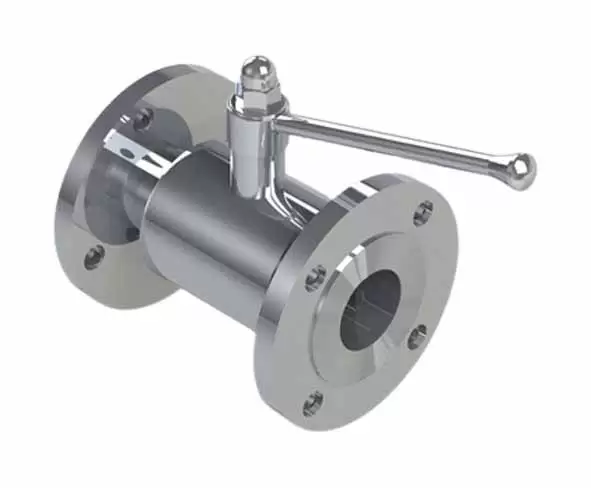
    Flanges to ASME B16.5, class 150 to 2500, raised face or ring joint, remain the maintainable default for process lines from about DN50. The valve unbolts for seat renewal or replacement, gasket and stud selection follow plant practice, and the rating system is unambiguous. Confirm face finish and whether gaskets and bolting are in the supply scope.

    06

    Tri-clamp ends

    Ferrule ends held by a clamp and elastomer gasket for hygienic lines that are broken down for cleaning. Specify ferrule size and standard, gasket material, internal surface finish, and consider cavity-filled seats so product cannot lodge around the ball.

    07

    The valve behind the ends

    Whatever the ends, the valve is still built to API 608 or ISO 17292 with ratings per ASME B16.34 and testing to API 598; fire-safe certification to API 607 or ISO 10497 applies where the medium demands it.

    What to state in the enquiry

    Pipe size and schedule, end connection type and standard, rating or class, thread form where applicable, body and trim material matched to the pipe for welded ends, seat material, medium and temperature, operation, quantity, and inspection or certification requirements. Indian manufacturers supply all five end styles for export and will hold bore and end-preparation tolerances to the stated piping specification.

    Submit an enquiry β†’
    Technical guide

    How Ball Valve End Connections Work

    Five joints, five sealing principles

    The ball and seats seal the bore; the ends seal the valve to the pipe, and each style does it differently. A threaded joint seals on the interference of taper threads assisted by sealant. A socket-weld joint seals by a fillet weld around the pipe circumference. A butt-weld joint fuses valve and pipe into continuous metal. A flanged joint clamps a gasket between machined faces under bolt load. A tri-clamp joint squeezes an elastomer gasket between two grooved ferrules. Understanding where each carries its load explains where each fails.

    Threaded joints

    Taper threads wedge tighter as they engage, and the sealant fills the spiral leak path the threads leave. Strength comes from the reduced wall at the thread root, which is why threaded joints are the weakest in bending and the first to fail under vibration or pipe strain; fatigue cracks start in the root. Every make-up and break also wears the threads, so repeated maintenance degrades the joint.

    Socket-weld joints

    The pipe bottoms in the socket and is withdrawn about 1.5 mm before welding so the gap can absorb weld shrinkage without cracking the fillet. The joint is strong in shear and simple to fit, but that same gap forms an internal crevice where stagnant liquid concentrates; in chloride service this is where crevice corrosion and under-deposit attack begin, which is why hygienic and corrosion-critical specifications exclude socket-weld.

    Butt-weld joints

    A full-penetration butt weld restores the pipe cross-section completely and can be volumetrically examined, so the joint is as reliable as the parent pipe. The cost is heat: welding temperature travels along the body toward the seats, and PTFE decomposes far below it. Three-piece bodies exist substantially for this reason β€” end caps are welded to the pipe with the centre section removed, then the trim is bolted back in unharmed.

    Flanged joints

    Bolt preload compresses the gasket enough to keep contact stress above the internal pressure trying to open the joint; the rating class defines how much pressure the flange and bolting can hold at temperature. Failures are almost always assembly failures: wrong gasket, uneven bolt-up, or pipe loads bending the joint open. The compensating virtue is that everything is renewable with hand tools.

    Tri-clamp joints

    The clamp draws two ferrules onto a gasket whose moulded profile leaves a nearly flush, crevice-free bore that drains and cleans in place. The elastomer is the limiting element: chemical attack, cleaning temperatures and over-clamping that extrudes the gasket into the bore set the maintenance interval.

    What this means in service

    Match the joint to the failure you cannot accept β€” vibration fatigue rules out threads, crevice corrosion rules out socket-weld, unplanned downtime argues for flanges, product purity argues for tri-clamp, and maximum integrity at temperature argues for butt-weld with a three-piece valve. Then state pipe schedule, end standard and material in the enquiry so the manufacturer machines ends that actually fit the line.

    Popular searches in End Connection Ball Valves

    Frequently Asked Questions

    Threaded, socket-weld or butt-weld for small-bore process lines?
    When do flanged ends earn their cost?
    How do I avoid wrecking the seats when welding in a weld-end ball valve?
    When are tri-clamp ends the right choice?