• Homeβ€Ί
  • Dual Plate Check Valves
  • Homeβ€Ί
  • Valvesβ€Ί
  • Dual Plate Check Valves
  • Dual Plate Check Valves

    Source dual plate check valves from India's verified manufacturers and exporters on Himalay. Browse the full range for industrial and export applications.

    Showing 1 items
    1 items
    operation type
    Dual Plate
    body material
    SS304
    SS316
    WCB
    end connection
    Wafer
    seat material
    Metal
    Viton
    trim material
    SS316
    Dual Plate Check Valves sourcing

    About Dual Plate Check Valves

    API 594 dual plate check valves with spring-loaded twin plates in wafer, lug and double-flanged patterns, DN50 to DN1200, in carbon steel, stainless and duplex grades.

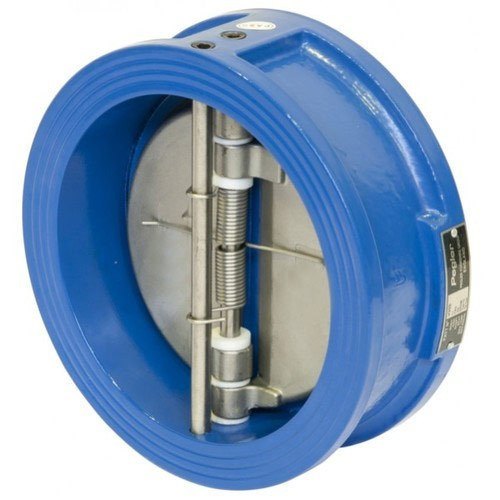
    A dual plate check valve, also called a double door or duo check valve, closes two spring-loaded semicircular plates against a central hinge post the instant forward flow decays, giving the fastest closure of any conventional check design and near immunity to slam. The body is a short wafer, lug or double-flanged ring built to API 594, which makes the valve a fraction of the length and weight of an equivalent swing check: a DN300 dual plate valve can weigh less than a quarter of the swing valve it replaces. That combination of non-slam closure and compactness makes it the default on pump discharge manifolds, cooling water circuits, HVAC risers, marine systems and pipelines ordered to API 6D. Indian manufacturers commonly offer bodies in WCB carbon steel, CF8 and CF8M stainless, duplex grades, aluminium bronze and ductile iron, with plates in matching or upgraded material, springs in Inconel or Monel for chloride and sour service, and seats in integral metal or renewable NBR, EPDM and Viton for drop-tight shut-off. Sizes run DN50 to DN1200 in ASME classes 150 to 600 as standard, with retainerless bodies available where hinge pin retainer penetrations are unacceptable on hazardous media. Testing is to API 598. State size, class, body pattern, body and plate materials, spring material, seat type, service medium, orientation and quantity in your enquiry.

    Buyer guide

    Specifying Dual Plate Check Valves: Pattern, Springs and Materials

    01

    What the valve is actually for

    A dual plate check valve stops reverse flow with two spring-loaded semicircular plates hinged on a central post. It exists to solve the two weaknesses of the swing check: slam and bulk. The plates travel a short arc under torsion spring load, so closure is complete before reverse flow can accelerate, and the short pattern body to API 594 fits between flanges where a swing check would need half a metre of pipe. It is the standard selection on pump discharge manifolds, cooling and fire water, HVAC, marine and offshore systems, and pipelines to API 6D.

    02

    Body patterns and when each is chosen

    Wafer bodies clamp between flanges on through-studs and are the economic default up to mid sizes and classes. Lug bodies bolt to each flange independently, allowing one side of the line to be opened, and are preferred for larger sizes, higher classes and maintenance-conscious plants. Double-flanged bodies suit large-diameter water and pipeline duty. Retainerless bodies remove the shell-penetrating hinge retainer plugs of the standard design and are specified for hydrocarbons, hydrogen, sour gas and toxic media where every potential leak path counts.

    03

    Materials

    Ductile iron and aluminium bronze serve water and seawater circuits; WCB carbon steel is the process default; CF8M stainless, duplex and super duplex cover corrosive and offshore duty. Plates match or upgrade the body. Springs deserve explicit attention: stainless for benign fluids, Inconel for chlorides and elevated temperature, Monel for sour and brackish service, since fatigued or corroded springs are the dominant failure item. Seats are integral metal or renewable resilient facings in NBR, EPDM or Viton for drop-tight duty. Indian manufacturers supply the full range with EN 10204 3.1 certification and third-party inspection for export orders.

    04

    Ratings, ends and standards

    Design and face-to-face follow API 594; pressure-temperature ratings follow ASME B16.34; testing follows API 598; pipeline valves add API 6D. Classes 150 to 600 and sizes DN50 to DN1200 are commonly stocked patterns in India, with higher classes and larger diameters made to order. Confirm the mating flange standard and bore, because the wafer body must centre on the studs and the plates must swing clear of the pipe bore.

    What to state in your enquiry

    Give size, class, body pattern, standard (API 594, and API 6D if pipeline), body, plate, spring and pin materials, seat type, mating flange specification, service medium and temperature, flow orientation including vertical runs, quantity, and testing and certification requirements. If the line sees pulsating or frequently reversing flow, say so: spring selection can be tuned, and it is far cheaper to tune it at the enquiry stage.

    Submit an enquiry β†’
    Technical guide

    How Dual Plate Check Valves Work

    The basic mechanism

    A dual plate check valve mounts two D-shaped plates on a vertical hinge pin at the centre of the bore, each loaded towards the closed position by one or more torsion springs. Forward flow folds the plates back against the spring torque; they float at the angle where flow force balances spring load, streamlined roughly parallel to the flow. As flow decays, the springs walk the plates back towards the seat continuously, so plate position tracks flow rate all the way down. By the time forward velocity reaches zero the plates are already at or on the seat, and reverse flow has nothing to slam.

    Why this is the non-slam mechanism

    Surge pressure at check valve closure is set by the reverse velocity at the instant of seating: the faster the reverse flow when the valve finally shuts, the harder the water hammer. A swing check with a heavy disc and a long arc closes late, at high reverse velocity. Dual plates have low mass, a short quarter-turn arc, and a spring that starts closing them while flow is still forward, so reverse velocity at seating is close to zero. That dynamic response, not the seat or body, is the entire reason the design exists, and it is why spring condition matters so much in service.

    Flow behaviour and pressure drop

    The plates and hinge post remain in the flow path even fully open, so pressure drop is higher than an equivalent swing check, and flow reaches the plates split into two crescents. Sizing still follows the same rule as every check valve: the plates must be firmly against the stop at normal flow. Oversized valves leave the plates hovering mid-travel, fluttering against the springs, and flutter is what fatigues springs and wears the hinge pin and plate ears. Downstream of elbows and pumps, swirl makes the two plates open unevenly; a few diameters of straight pipe upstream calms this.

    Failure modes

    Spring fatigue and corrosion lead the list, which is why Inconel or Monel springs are specified for chlorides and sour service. Hinge pin and plate ear wear follows flutter. Resilient seat facings swell or harden in the wrong medium. Stringy solids and rags wrap the central hinge, holding plates off the seat, so the design is a poor choice for raw sewage. In standard bodies the hinge pin retainer plugs penetrate the shell and can weep on gas duty; retainerless designs exist precisely to remove that path.

    Orientation

    Horizontal flow and vertical upward flow are both routine. Vertical downward flow works only with springs selected to close the plates against gravity plus the fluid column, so it must be declared at enquiry.

    What this means for specification

    State the real flow range, the medium and temperature for spring and seat selection, the orientation, and whether the system reverses quickly. A dual plate valve with the right springs, sized to hold its plates open at duty flow, is the quietest check valve available; the same valve oversized or with the wrong spring alloy becomes a fatigue machine.

    Popular searches in Dual Plate Check Valves

    Frequently Asked Questions

    Why choose a dual plate check valve over a swing check?
    Wafer, lug or double-flanged body, and when does retainerless matter?
    What spring and seat should I specify?
    What should my dual plate check valve RFQ include?