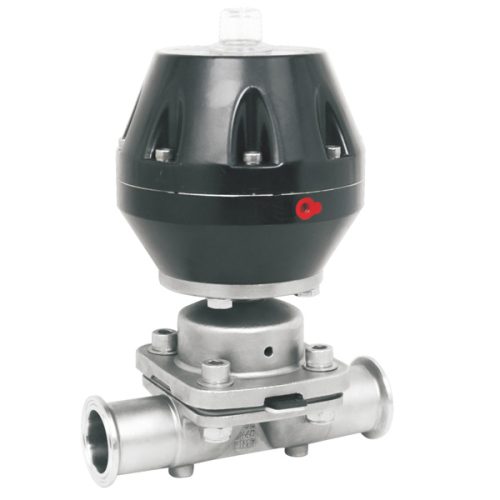
Diaphragm Valves sourcingAbout Diaphragm Valves
Diaphragm valves across 974 listed configurations — weir (metallic or thermoplastic body) and straight-through (metallic only), DN15 to DN300, in cast iron, SS316, PVC-U, CPVC and PVDF.
Diaphragm valves close by pressing a flexible diaphragm against a weir or the body floor, which means the diaphragm — not a packed stem — is the only barrier between the medium and the outside. There is no stem-leak path and nothing in the flow stream but the diaphragm face, which is why the family dominates corrosive, abrasive and hygienic service across chemical, water treatment and pharmaceutical plant. Himalay lists diaphragm valves in two body geometries: weir type, where a raised weir in the body reduces diaphragm travel and gives the best throttling behaviour, and straight-through, which keeps a self-draining, unobstructed bore suited to slurries and viscous or solids-bearing media. The catalogue spans 974 configurations from DN15 to DN300, rated PN10 or PN10/PN16. Bodies are cast iron, SS316, or moulded thermoplastic — PVC-U, CPVC and PVDF; thermoplastic bodies are listed on the weir-type geometry only, not straight-through. Cast iron bodies are offered ebonite-lined, unlined, glass-lined or PFA-lined; SS316 and thermoplastic bodies are unlined. Diaphragms are EPDM, a 2-ply PTFE/EPDM-backed construction, or NBR. End connections are flanged on all metallic bodies; PVC-U and CPVC thermoplastic bodies are offered flanged or solvent-cement socket, PVDF is flanged only. Operation is manual handwheel, pneumatic actuated, or bare stem for third-party actuation. Metallic-bodied valves follow BS EN 13397 and IS 13095; thermoplastic-bodied valves follow EN ISO 16138. State the medium, its corrosivity and solids content, and any lining or diaphragm-material preference in your enquiry.