Blow Moulds
Source blow moulds from India's verified manufacturers and exporters on Himalay. Browse the full range for industrial and export applications.
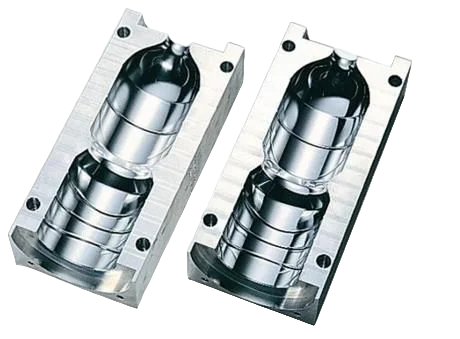
About Blow Moulds
Blow moulds are the hollow-cavity tools used in blow moulding, where a heated plastic parison or preform is inflated against the cooled mould wall to form hollow parts such as bottles, containers, drums, tanks, and ducting. The route covers extrusion blow moulding (EBM), injection blow moulding (IBM), and injection stretch blow moulding (ISBM for PET), and is the standard process for high-volume hollow plastic packaging and industrial containers.
Because clamping pressures are low compared with injection moulding, blow moulds are commonly machined from aluminium alloys (such as 7075) for good thermal conductivity and fast cycles, with beryllium-copper inserts at pinch-off and neck zones; high-wear or long-run tools may use pre-hardened P20 steel (around HRC 28-32) for the neck/finish and pinch areas. Cooling-channel design drives cycle time, and cavity count is set by the blow machine and output target. PET preform moulds for ISBM are typically hardened steel for tight neck tolerances.
Materials processed include HDPE, PP, PET, PVC, and PC; mould surfaces are textured or polished and pinch-offs are wear-treated.
Configuration covers single and multi-cavity moulds, shuttle and rotary machine compatibility, and integrated venting and pinch-off, with first-article verification on the blown part.
Himalay coordinates material traceability via EN 10204 3.1 certificates for the tool material where requested, mould trial reports, dimensional and wall-thickness reports on samples, food-contact and RoHS/REACH declarations where relevant, and CE support, all coordinated as part of the standard order flow.