The basic mechanism
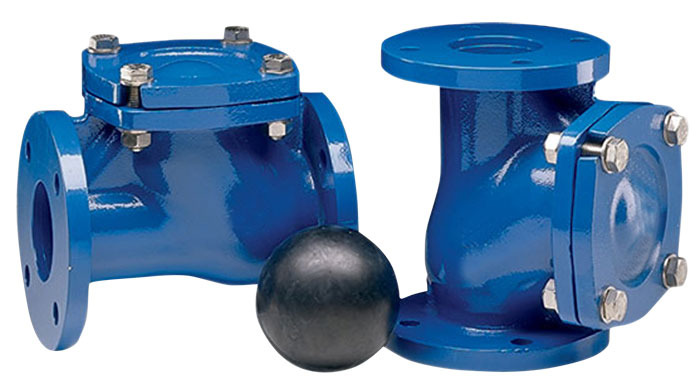
A ball check valve seats a ball on a circular seat at the inlet. Forward flow generates enough force to lift or roll the ball off the seat and carry it into a chamber offset above or beside the main flow path, where it rests while flow continues past it. When the pump stops, the ball leaves the chamber under its own weight, rolls back down the guide surfaces of the body, and lands on the seat; reverse pressure then loads it into the seat and the line is closed. The sealing geometry is a sphere on a circle, which is self-aligning: the ball cannot land crooked the way a disc can, and it does not need a hinge or guide to find the seat.
Why the design tolerates dirty media
Every other check valve carries its closure member on hardware that lives in the flow: hinge pins, springs, bushes, guides. Fibre wraps hinges, grit packs guides, and springs fatigue. The ball check has none of these; its only moving part is the ball itself, and its only critical surfaces are the ball skin and the seat. Sewage-pattern bodies are shaped so the bore through the valve is full and smooth, letting rags and solids pass, and the chamber parks the ball fully out of the stream. Each closure also lands the ball in a new random orientation, so wear and abrasion distribute across the entire spherical surface instead of concentrating on one sealing band, which is why worn ball checks in grit-laden service stay tight long after a disc valve would leak.
Closure dynamics and their limits
The ball is heavy and travels a comparatively long, unguided path back to the seat, so closure is slow by check valve standards. On single-pump sewage rising mains with gentle rundown this is harmless. On fast-reversing systems, parallel pump headers or long mains with high static head, the ball can still be off the seat when reverse flow is established, and it then arrives at the seat carried by reverse velocity, producing a thump and a surge. Where reversal is fast, either a spring-loaded ball pattern or a different design such as an axial nozzle check is the correct answer; no ball material choice fixes closure speed.
Failure modes
Rubber coatings swell in incompatible fluids, harden with age and can shed after repeated impact; the exposed steel then corrodes and the seal roughens. Seats groove where grit is dragged across them under high differential. In dense slurries a ball selected for water may float or settle too slowly to reseat, a specific gravity problem, not a defect. In continuous high flow an undersized chamber lets the ball hang partly in the stream, rumbling and wearing.
Orientation
Gravity return fixes the rules: horizontal installation with the chamber up, or vertical upward flow with the ball falling back onto a seat below. Vertical downward flow is excluded for gravity patterns.
What this means in service
Tell the manufacturer the true medium, solids, fibre content, specific gravity, flow range and orientation. Ball weight, coating, chamber shape and seat material are all chosen from those facts, and a ball check chosen well is the most neglect-tolerant valve on a sewage scheme.