• Homeβ€Ί
  • 3-Way Solenoid Valves
  • Homeβ€Ί
  • Valvesβ€Ί
  • 3-Way Solenoid Valves
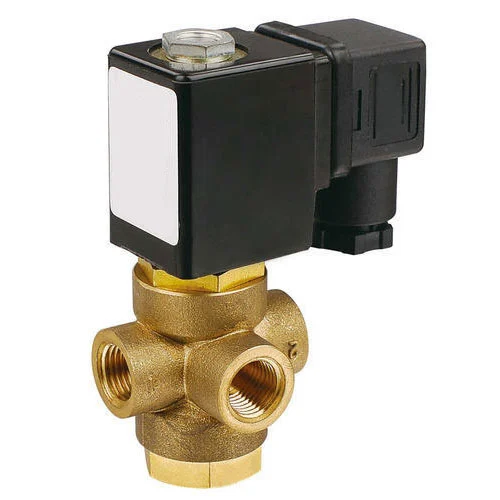
  • 3-Way Solenoid Valves

    Source 3-way solenoid valves from India's verified manufacturers and exporters on Himalay. Browse the full range for industrial and export applications.

    Showing 1 items
    1 items
    operation type
    Solenoid Coil
    body material
    Brass
    SS304
    end connection
    Threaded
    seat material
    EPDM
    NBR
    trim material
    SS304
    3-Way Solenoid Valves sourcing

    About 3-Way Solenoid Valves

    3/2 solenoid valves for diverting, venting and actuator piloting, in NC, NO and universal functions, inline and NAMUR mount, brass, stainless and aluminium bodies.

    A 3-way solenoid valve has three ports and two positions (3/2): it connects a common port alternately to a pressure source or to an exhaust, which lets it do jobs a 2-way valve cannot, namely pressurise and then vent a volume, divert flow between two paths, or select between two supplies. Its largest industrial use is piloting spring-return pneumatic actuators and single-acting cylinders: energise to stroke the actuator, de-energise to exhaust the air and let the spring return it. NAMUR-pattern valves bolt directly onto the actuator interface, eliminating tubing. Functions are normally closed (outlet vented at rest), normally open, and universal, where any port may be pressurised for diverting or selecting duty, including vacuum. Indian manufacturers commonly supply direct acting 3/2 valves from 1/8 to 1/2 inch in brass, SS316 and aluminium, with NBR, FKM or PTFE seals, DC and AC coils to IP65, and Ex d or Ex m hazardous-area options. In your enquiry state function (NC, NO or universal), port size and orifice or Kv, inline or NAMUR mounting, medium, pressure range, coil voltage, enclosure or certification needs and quantity.

    Buyer guide

    Specifying 3-Way Solenoid Valves: Function, Mounting, Media and Coils

    01

    What the valve is for

    A 3/2 solenoid valve connects its outlet alternately to a pressure port or an exhaust port, so it can pressurise a volume and then vent it, which a 2-way valve cannot do. That makes it the standard pilot for spring-return pneumatic actuators and single-acting cylinders, and the right choice for blow-off nozzles, air brakes and chucking, filling-and-draining sequences, and diverting or selecting between two flow paths.

    02

    Function first

    Normally closed valves block pressure and vent the outlet at rest; energising connects pressure to outlet. This is the default for actuator piloting because power loss exhausts the actuator to its spring-fail position. Normally open valves keep the outlet pressurised at rest. Universal-function valves allow any port to be pressurised, covering diverting, selecting and vacuum duties, though often at a reduced rating in the non-standard flow direction, so state your actual flow diagram in the enquiry.

    03

    Inline or NAMUR

    Threaded inline bodies from 1/8 to 1/2 inch BSP or NPT suit panel and remote mounting. NAMUR-pattern valves bolt straight onto the standardised pilot interface of quarter-turn actuators, removing tubing and leak points; many convert between 3/2 and 5/2 function with a gasket or spool change so one valve type serves both spring-return and double-acting actuators across a plant.

    04

    Construction and media

    Most 3/2 valves are direct acting, so they operate from zero differential, which also suits vacuum. Brass bodies with NBR seals cover instrument air and neutral gases; SS316 with FKM or PTFE covers corrosive media, offshore and hygienic plants; aluminium spool valves serve high-cycle pneumatics. On instrument air, state the air quality; unlubricated dry air argues for seal materials and grease specified accordingly.

    05

    Electrics and certification

    Coils are commonly 24 V DC and 24/110/230 V AC, class F or H, ED 100% duty, IP65 with DIN-type connector or IP67 with moulded cable; NEMA 4X for washdown. On classified areas specify flameproof Ex d or encapsulated Ex m construction to ATEX/IECEx, or IS/IEC 60079 for Indian sites; low-power coils below 2 W are available for PLC and intrinsically safe loop budgets. VDE 0580 applies to the solenoid assembly. Manual overrides, latching (impulse) versions and mounting orientation limits are worth confirming at enquiry stage.

    What to state in your enquiry

    Function with flow diagram, port size and thread standard, orifice or Kv, inline or NAMUR mounting, medium and quality, minimum and maximum pressure, temperatures, body and seal materials, coil voltage and power limit, enclosure and hazardous-area rating, manual override, quantity and delivery schedule. Indian manufacturers export these valves widely and will support type-test certificates and third-party inspection on request.

    Submit an enquiry β†’
    Technical guide

    How 3-Way Solenoid Valves Work

    Three ports, two states

    A 3/2 valve has a pressure port, an outlet and an exhaust, with a moving element that always connects the outlet to exactly one of the other two. In the classic direct acting poppet design the plunger carries a seal at each end inside a core tube with an orifice above and below it. De-energised, the spring holds the lower seal on the pressure orifice while the upper exhaust orifice is open, so the outlet vents. Energised, the plunger lifts: the lower orifice opens, the upper seal closes the exhaust, and pressure flows to the outlet. The changeover is inherently break-before-make over a few milliseconds, and a small puff of media leaves the exhaust at each switch, which matters when the medium is anything other than air.

    Why it pilots actuators

    A spring-return pneumatic actuator needs its air chamber filled to stroke and emptied to return. The 3/2 valve does both: energise to pressurise, de-energise to exhaust through the valve's third port. The exhaust path size, not just the supply path, sets the actuator return speed, so a valve chosen only on supply Kv can give a slow or lazy spring stroke. On NAMUR-mounted valves the porting runs directly through the interface, and the same body often converts to 5/2 for double-acting actuators by swapping a gasket plate, which is why the NAMUR pattern dominates on quarter-turn automation.

    Spool versus poppet

    Poppet valves seal on elastomer faces, tolerate modest dirt, switch fast and are the norm in brass and stainless process versions. Spool valves slide a lapped or elastomer-sealed spool across ports in a sleeve; they give balanced forces, so higher pressures switch with small coils, and they convert easily between functions, but they need clean, ideally lubricated air and leak slightly more across ports.

    Universal function and vacuum

    In a universal valve the internals are pressure-balanced so any port can carry the higher pressure, letting the same valve divert one supply to two consumers or select between two supplies. Because direct acting designs need no differential to operate, they also switch vacuum lines reliably, connecting a chuck alternately to vacuum and to atmosphere for release. Ratings usually differ by flow direction, so the datasheet direction tables matter more here than the headline pressure.

    Failure modes

    Exhaust ports left open collect dust and insects; fit a silencer or breather, and pipe the exhaust away on wet or classified plants. Continuous energisation heats the coil, and ambient plus media temperature above the insulation class shortens life sharply. On dirty air, poppet seats wear and spools score; a 5 micron filter upstream is cheap insurance. If the valve must hold position through a power loss rather than fail to one state, specify a latching impulse version rather than accepting the standard spring return, and say so explicitly in the enquiry.

    Popular searches in 3-Way Solenoid Valves

    Frequently Asked Questions

    When do I need a 3-way valve instead of a 2-way?
    What is a NAMUR solenoid valve and when should I specify it?
    NC, NO or universal function β€” how do I choose?
    What should my RFQ for 3-way solenoid valves include?