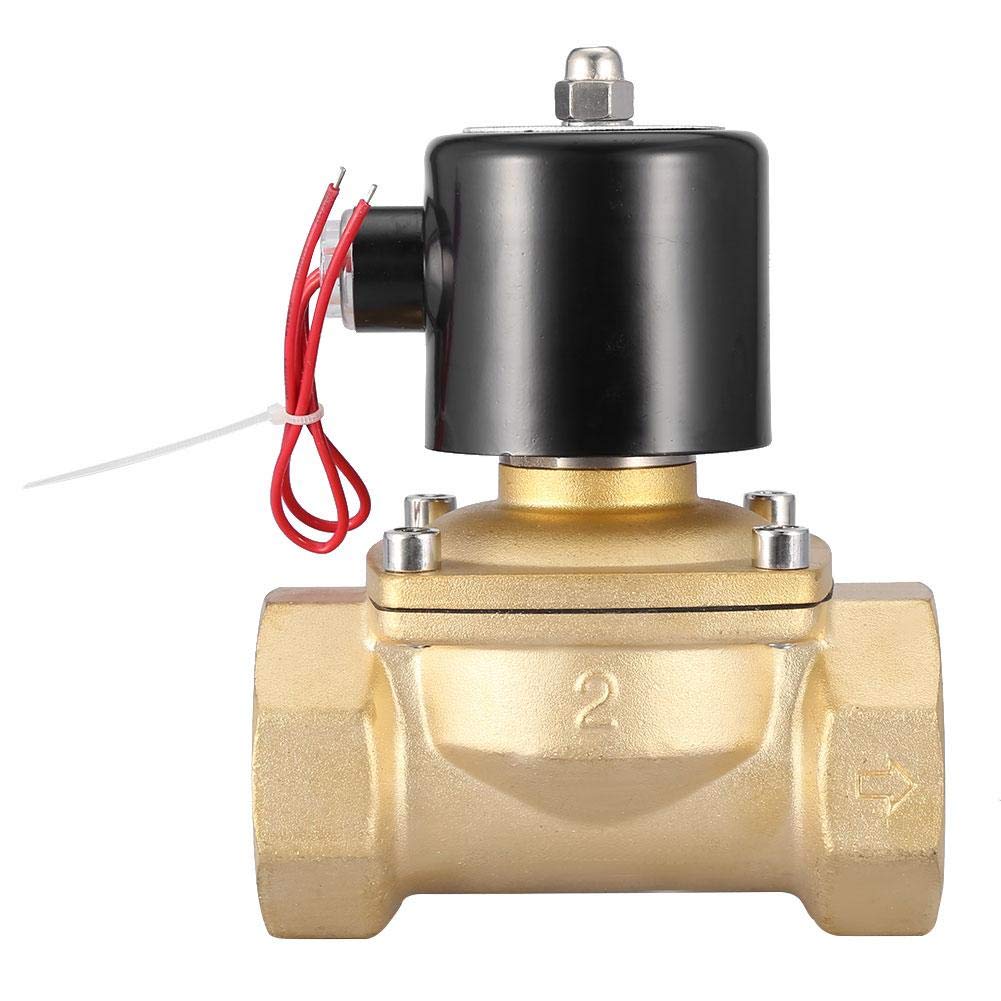
2-Way Solenoid Valves
2-way solenoid valves are the simplest electrically actuated on/off valves: two ports β one inlet, one outlet β and a single flow path that the energised coil either opens or closes. They are the workhorse of fluid on/off control: dosing, batching, isolating, and starting/stopping flow of air, water, steam, oil, and many process fluids under PLC control. A normally-closed (NC) valve passes flow only when energised; a normally-open (NO) valve passes flow until energised, an important fail-state choice for the application.
The two construction principles are direct-acting and pilot-operated. Direct-acting 2-way valves move the seal directly with the plunger, so they work from zero differential pressure (including vacuum and dead-end service) but are limited in orifice and flow for a given coil. Pilot-operated (servo-assisted) 2-way valves use the line's own minimum differential pressure to lift a diaphragm, giving much higher flow from a compact coil β the standard choice for larger water, air, and steam lines that always have some pressure drop. Hung-diaphragm and forced-lift variants extend pilot-operated valves down to low or zero differential.
Materials are brass and SS316 (with aluminium for air service) bodies, with NBR, FKM/Viton, EPDM or PTFE seals/diaphragms selected for media and temperature; steam valves use PTFE and high-temperature elastomers. Ends are threaded NPT/BSP. Coils are 24 VDC or 110/230 VAC, in IP65/IP67 weatherproof or ATEX/IECEx Ex d/Ex m enclosures for hazardous areas.
Being electrically actuated, configuration centres on coil voltage, NC/NO rest state, direct-acting vs pilot-operated, minimum/maximum differential pressure, orifice/Cv, and enclosure rating rather than mechanical actuators. Himalay's MSME partners manufacture 2-way solenoid valves with electrical and leak testing, IP/ATEX-IECEx documentation where specified, material traceability, and PED-CE (EU), SABER (Saudi Arabia), and NACE MR0175 (sour service) coordinated as part of the standard order flow.