The problem of the fragile tank
Storage tanks are designed to carry the weight of their contents, not to resist external pressure. A flat-bottomed welded tank may have a design vacuum of only 2 to 6 millibars, a pressure difference smaller than that across a domestic extractor fan. Vacuum inside a tank arises whenever vapour space volume grows or its temperature falls faster than air can get in: liquid pumped out, condensation of the vapour when cold rain strikes a hot roof, or simple overnight cooling. The vacuum relief valve exists to admit gas fast enough that the pressure difference never reaches the buckling threshold.
The weight-loaded pallet mechanism
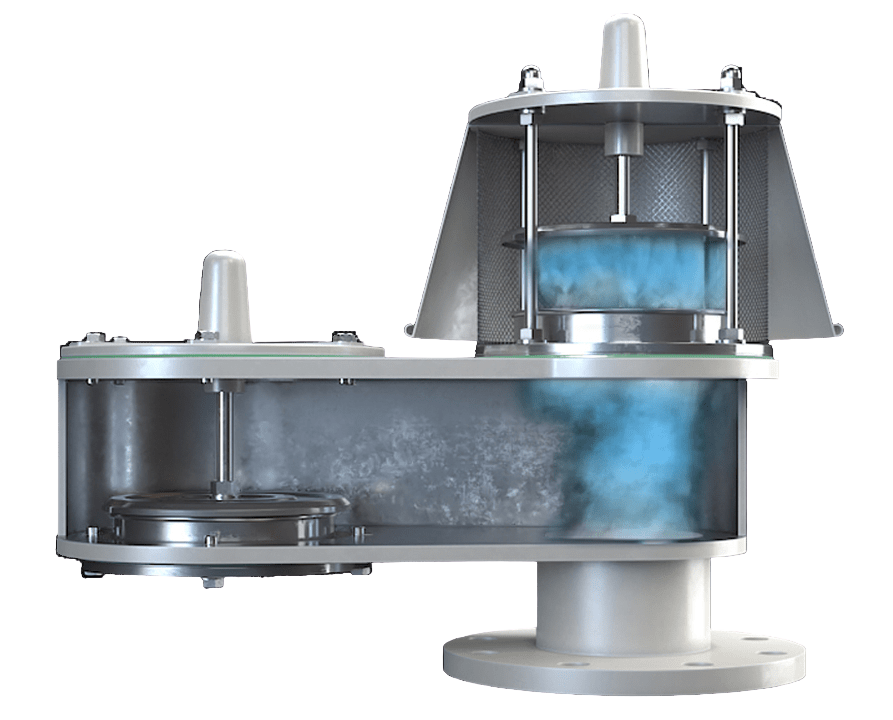
In the standard design a circular pallet, guided by a central stem or pins, rests by gravity on an annular seat. Atmospheric pressure acts on top, tank pressure underneath. While the tank is at or near atmospheric pressure the pallet's weight keeps it seated. When tank pressure falls, the net upward force from the atmosphere grows until it equals the pallet weight; that is the set vacuum, fixed purely by mass and seat area, which is why settings are changed by adding or removing calibrated weight discs. Past the set point the pallet lifts and air flows under it into the tank.
Lift, capacity and the 100 percent overvacuum convention
A pallet valve does not pop open like a steam safety valve; lift increases progressively as the vacuum deepens. Manufacturers therefore publish flow curves, and rated capacity is conventionally quoted at some overvacuum beyond the set point, often up to twice the set value for very low settings. This is why the set vacuum must sit well below the tank design vacuum: the valve needs working room to develop full flow before the tank reaches its structural limit.
Seat tightness and product loss
Near the set point a metal-to-metal seated pallet weeps, and on a tank breathing daily that leakage is continuous product and emission loss. Modern valves use lapped seats with PTFE or FEP films and air-cushion designs that hold tightness to within around 90 percent of set, which pays for itself in reduced vapour loss on volatile products.
Failure modes
The classic failure is a stuck pallet: gums, polymers, ice or corrosion products bond the pallet to the seat, and the tank pulls vacuum until it buckles. This is a specification issue as much as a maintenance one, since FEP-faced pallets, jacketed bodies and appropriate materials prevent most sticking. The second failure is undersizing, where the valve opens correctly but cannot pass the required air flow within the design vacuum; the calculation to API 2000 exists precisely to prevent it. The third is blocked flame arrester elements robbing the valve of capacity, which is why arresters must be included in the sizing, not added afterwards.
Why orientation and location matter
Weight-loaded pallets only work vertically, and the valve must connect to the vapour space with a generously sized, unvalved or car-sealed-open nozzle. A vacuum valve isolated for maintenance while the tank is pumped out is the standard opening scene of tank collapse case histories, which is why specifying the mounting arrangement is part of specifying the valve.