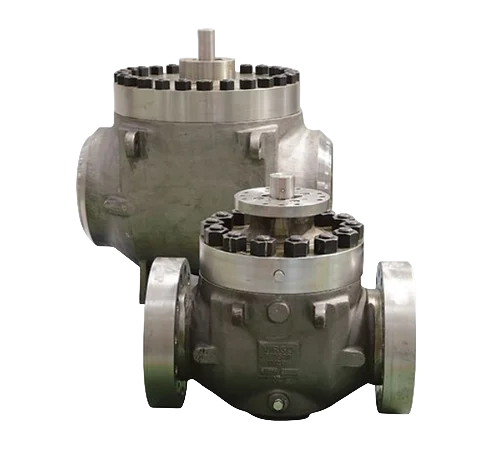
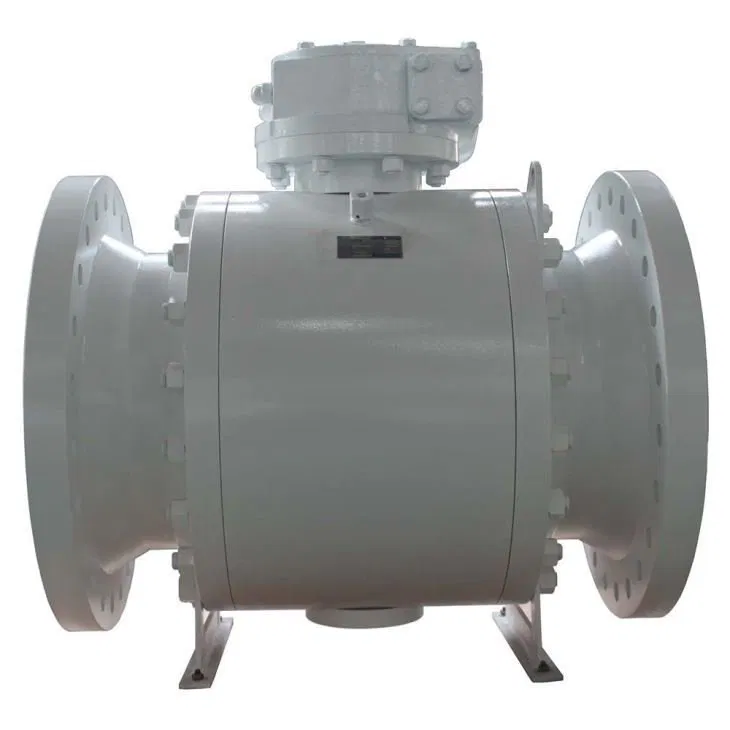
Fixed ball, moving seats
In a trunnion mounted valve the ball is held by a top trunnion integral with or coupled to the stem and a bottom trunnion post, both running in bearings. The ball cannot move downstream, so sealing is done the other way round from a floating valve: each seat ring is free to slide axially in its pocket and is pushed onto the ball by springs, with line pressure acting on the exposed piston area of the ring to add force in proportion to pressure. Sealing therefore starts at zero pressure, from spring load alone, and strengthens with pressure without ever transferring the full ball load onto a polymer seat.
Why torque stays low
The pressure force on the ball is carried by the trunnion bearings, not the seats, so friction at the seat face stays roughly constant with pressure. This is what makes large high-class valves operable with gearboxes and modest actuators, and it is the fundamental reason the design scales where floating valves cannot.
Piston effect
Whether a seat relieves or holds cavity pressure is set by the relative sealing diameters on the ring. In a single piston effect seat, pressure trapped in the body cavity acts on a net area that pushes the seat away from the ball, so cavity overpressure vents into the bore automatically. In a double piston effect seat the net area works the other way and cavity pressure presses the seat harder onto the ball, so the seat seals from both directions but the cavity must be protected by an external relief valve.
Double block and bleed
With both seats sealing against their respective ends, the body cavity between them can be vented through a bleed connection. A dry bleed proves both seats are holding, which is why DBB trunnion valves are used for positive isolation before maintenance and at custody transfer points, replacing two valves and a spool.
Sealing hierarchy
The primary seal is usually a polymer insert — nylon, PEEK or filled PTFE — retained in the metal seat ring; behind it the metal ring itself gives a secondary seal, and sealant injection points allow a viscous compound to be pumped to the seat face as an emergency measure if the insert is damaged. The stem is sealed by O-rings or graphite packing with its own injection point on larger valves.
Fire behaviour
Fire-safe designs retain a metal-to-metal seat path and graphite secondary seals so that when polymer inserts burn away the valve still limits leakage to the rates defined in API 607 and ISO 10497.
Failure modes
Debris packing the seat pockets can stop the rings following the ball, wax and hydrates can fill the cavity and jam the mechanism, bearing wear from side load shows up as rising torque, and in double piston effect valves a blocked or missing cavity relief can overpressure the body on thermal expansion. Most are prevented by choosing the right seat configuration, keeping the cavity drained and vented per the operating philosophy, and stating the service honestly, including sand, wax and H2S, in the enquiry.