• Home›
  • Double Eccentric Butterfly Valves
  • Home›
  • Categories›
  • Valves›
  • Double Eccentric Butterfly Valves
  • Double Eccentric Butterfly Valves

    Source double eccentric butterfly valves from India's verified manufacturers and exporters on Himalay. Browse the full range for industrial and export applications.

    Showing 1 items
    1 items
    operation type
    Actuator
    Gear
    body material
    DI
    SS304
    SS316
    WCB
    end connection
    Flanged
    seat material
    EPDM
    PTFE
    Viton
    trim material
    SS316
    Double Eccentric Butterfly Valves sourcing

    About Double Eccentric Butterfly Valves

    High-performance double eccentric butterfly valves in wafer and lug patterns, DN50 to DN1200, ASME Class 150 and 300, with RTFE, PTFE or fire-safe seats.

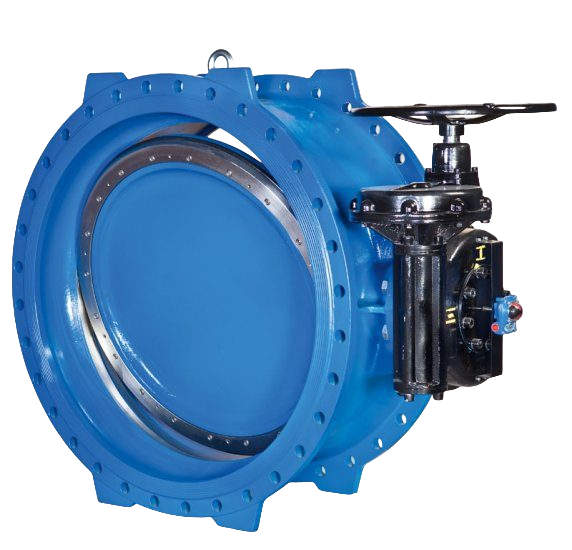
    A double eccentric (double offset) butterfly valve, widely called a high-performance butterfly valve, mounts its shaft behind the disc sealing plane and offset from the pipe centreline. The two offsets create a cam action that lifts the disc off the seat almost immediately on opening, so the seat is not rubbed through the stroke as it is in a concentric valve. This allows harder seat materials, higher pressures and temperatures, and long cycle life. Indian manufacturers commonly supply wafer and lug bodies in WCB carbon steel, CF8, CF8M and duplex, ASME Class 150 and 300 or PN 16 to PN 40, with RTFE, PTFE, metal or fire-safe seats certified to API 607. Typical duties are steam, thermal fluids, hydrocarbons, chemicals and gas, replacing gate and globe valves where weight and space matter. Design and testing follow API 609 Category B, EN 593, ASME B16.34 and API 598, with face-to-face to ISO 5752. An enquiry should state size, class, body pattern, body and disc material, seat type, service medium, temperature, differential pressure, operator or actuation, fire-safe requirement and quantity.

    Buyer guide

    Specifying Double Eccentric Butterfly Valves: Seat, Class and Materials

    01

    What the valve is actually for

    A double eccentric butterfly valve, the high-performance butterfly valve of process industry, isolates steam, hydrocarbons, thermal oil, gases and chemicals at pressures and temperatures beyond what a rubber-lined concentric valve survives. Its shaft sits behind the disc sealing face and off the pipe centreline, so the disc cams away from the seat as it opens instead of rubbing across it, which is what allows hard seats and long cycle life.

    02

    Pressure class and body pattern

    Standard offerings are ASME Class 150 and 300, or PN 16 to PN 40, in wafer and lug patterns; lug bodies allow downstream removal and end-of-line duty at a confirmed dead-end rating. Face-to-face dimensions follow ISO 5752 and API 609, and pressure-temperature ratings follow ASME B16.34 for the body material.

    03

    Body, disc and shaft materials

    WCB carbon steel covers general hydrocarbon and steam duty; CF8 and CF8M stainless cover corrosive and clean services; LCB or LCC for low temperature; duplex grades for chlorides and seawater. Shafts are typically 17-4PH, SS316 or duplex, sized for the published torque. Indian foundries pour all of these grades routinely and supply material certificates to EN 10204 3.1.

    04

    Seat selection is the core decision

    Virgin PTFE gives bubble-tight shutoff and wide chemical resistance; RTFE adds wear life and pressure capability and is the usual default; metal seats extend temperature beyond soft-seat limits at a relaxed leakage class. For flammable media, specify a fire-safe seat arrangement tested to API 607, where a secondary metal seat takes over after the polymer is destroyed.

    05

    Shutoff and direction

    Soft-seated high-performance valves are normally tested to API 598 with zero visible leakage. Most designs are bidirectional but with a preferred direction and a reduced reverse rating, so declare any reverse-pressure case.

    06

    Operation and actuation

    Gear operators are standard; for automated duty specify the ISO 5211 pad, the actuator type and the seating torque margin, remembering that breakaway torque at full differential pressure sizes the actuator, not running torque.

    What to state in the enquiry

    Size, class, wafer or lug pattern, body, disc, shaft and seat materials, medium with operating and design temperature, maximum differential pressure and flow direction, fire-safe requirement, operator or actuation details, governing standards (API 609 Category B, EN 593, ASME B16.34), testing to API 598, quantity, delivery point, and export packing or third-party inspection where the order ships out of India.

    Submit an enquiry →
    Technical guide

    How Double Eccentric Butterfly Valves Work

    The two offsets and what each does

    The first offset places the shaft behind the plane of the disc sealing face, so the sealing edge is an uninterrupted circle with no shaft bosses passing through it. The second offset moves the shaft slightly to one side of the pipe centreline. Together they turn the disc's motion into a cam action: the instant the disc leaves the closed position, its sealing edge swings away from the seat rather than sliding around inside it. Contact between seat and disc occurs only over the last few degrees of closing.

    Why that changes everything

    In a concentric valve the disc scrubs the seat through the whole stroke, which limits seats to soft rubber and limits life under frequent cycling. With rubbing eliminated, the seat can be PTFE, reinforced PTFE or metal; pressure and temperature limits climb to Class 300 and beyond; and cycle life stretches into the tens of thousands. Sealing is achieved by the disc edge pressing into a seat ring clamped in the body, and many designs make the seat slightly pressure-energised so line pressure improves the seal rather than fighting it.

    Torque behaviour

    The torque curve is dominated by breakaway at the seat and by dynamic torque from the flow trying to slam the disc at mid-stroke. Dynamic torque rises with differential pressure and peaks around 70 to 80 degrees open, which is why actuator sizing uses the manufacturer's torque table at the actual pressure drop, not a generic figure. Undersized actuators on high-pressure-drop gas service are a classic cause of valves that stall mid-stroke.

    Flow and control

    The characteristic is close to equal percentage through the mid-range, and high-performance valves are legitimately used for control duty, not just isolation, provided the drop stays within the seat's erosion and the body's cavitation limits. On liquids with high drops, check cavitation; on gases, check choked flow and noise.

    Failure modes that matter

    Soft seat damage from over-temperature or cold flow under sustained load shows up as seat leakage that worsens with time; graphite or PTFE stem packing wear shows as external weeping; disc edge damage from debris or from cavitation shows as leakage that no seat replacement cures. Fire-safe designs to API 607 accept that the polymer seat will be destroyed in a fire and rely on a machined secondary metal contact plus graphite packing to keep leakage within the tested limits.

    Direction sensitivity

    With the shaft downstream the pressure helps hold the disc into the seat; reversed, the same pressure works to push the disc off it, which is why reverse ratings are lower and why the arrow on the body deserves respect during installation. Understanding these mechanics is what separates a valve that reaches its rated cycle life from one replaced at the first shutdown.

    Popular searches in Double Eccentric Butterfly Valves

    Frequently Asked Questions

    When should I move from a concentric to a double eccentric valve?
    RTFE, PTFE or fire-safe seat — how do I choose?
    Are double eccentric valves bidirectional?
    What should my RFQ for high-performance butterfly valves include?